


What is the working principle of HTTPS? What are its special applications?
When a browser, mobile application, industrial terminal, cloud service, or API client connects to a server, the information may pass through routers, access networks, proxy systems, wireless links, carrier networks, and public internet infrastructure. Without protection, requests and responses may be exposed to interception, tampering, impersonation, session theft, or data leakage.
HTTPS exists to make web communication more trustworthy. It does not change the basic purpose of HTTP, which is still request and response. What it changes is the security layer around that exchange: who the client is talking to, whether the data is encrypted, whether the message has been modified, and whether sensitive information can safely travel across an untrusted network.
A secure connection begins before the web content appears
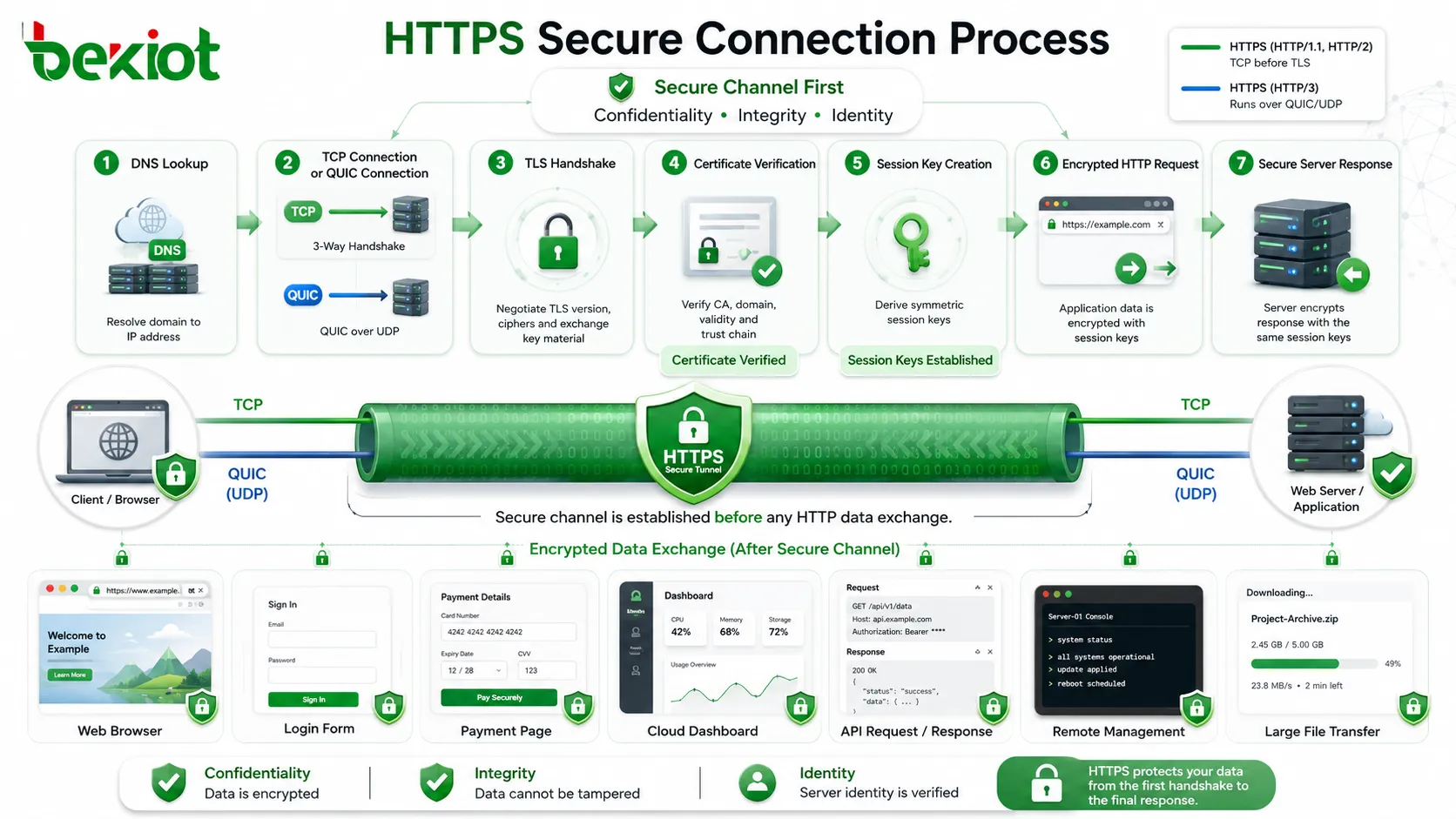
When a user enters a web address that starts with https://, the visible page is only the final result of several security steps. Before the browser shows the page, it must locate the server, establish a network connection, verify the server’s identity, negotiate cryptographic parameters, create session keys, and then send HTTP data through an encrypted channel.
This is why HTTPS should not be understood as a separate web language. It is better understood as HTTP running inside a secure transport layer. The browser and server still exchange methods such as GET, POST, headers, cookies, status codes, and response bodies. The difference is that these HTTP messages are protected by TLS before they move across the network.
The most important idea is that the client should not trust the network path. A user may be using public Wi-Fi, a corporate gateway, a mobile carrier, a hotel network, or an unknown access point. HTTPS assumes that the path may be observed or interfered with, so it builds security between the client and the legitimate server rather than relying on the safety of intermediate networks.
In practical terms, HTTPS provides three major protections. First, encryption prevents outsiders from reading the content of the communication. Second, authentication helps the client confirm that the server is the real owner of the domain. Third, integrity protection helps detect whether the data has been changed during transmission. These three protections work together. Encryption alone is not enough if the server identity is fake, and identity verification is not enough if messages can still be modified.
The path from address input to protected exchange
The process usually begins with address resolution. The client needs to know which IP address corresponds to the domain name. After DNS resolution, the client connects to the server. For conventional HTTPS over TCP, the client usually establishes a TCP connection first and then starts the TLS handshake. For HTTP/3, the secure connection is built over QUIC, which runs on UDP and integrates transport and encryption more closely.
After the connection is prepared, the TLS handshake begins. The purpose of the handshake is not to transmit the whole website content. Its purpose is to agree on how the later communication will be protected. During this stage, the client and server exchange supported protocol versions, cipher suites, random values, certificate information, and key exchange data.
Once the handshake succeeds, the client and server derive shared session keys. These keys are then used for symmetric encryption of the actual application data. Symmetric encryption is used because it is much faster for ongoing communication than public-key operations. The public-key part is mainly used during identity verification and key establishment, while the bulk of the traffic is protected using shared keys created during the handshake.
Only after these steps can the browser safely send the HTTP request and receive the server response. The user may feel that the web page loads directly, but the underlying process is carefully staged. This design allows HTTPS to protect everything from simple page browsing to login forms, payment requests, API calls, cloud dashboards, remote management pages, and large file transfers.
Certificate verification creates server identity trust
One of the most important parts of HTTPS is certificate verification. When the server presents a digital certificate, it is not simply showing a label. The certificate connects the server’s domain name with a public key and includes information that allows the client to verify whether the certificate was issued by a trusted certificate authority.
The client checks whether the certificate matches the requested domain name. If a user visits example.com, the certificate must be valid for that domain or a suitable wildcard or subject alternative name. A certificate for another domain should not be accepted. This prevents a server from pretending to be a different website simply by presenting any valid certificate.
The client also checks the certificate chain. A server certificate is usually linked to one or more intermediate certificates and eventually to a trusted root certificate installed in the browser, operating system, or application trust store. If the chain cannot be validated, the client may warn the user or block the connection depending on policy.
Expiration is another part of verification. Certificates are valid only for a defined period. If a certificate has expired, the client cannot assume that the identity binding is still valid. This is why certificate renewal is a basic operational requirement for HTTPS. Even a technically healthy website can become unreachable or distrusted if the certificate expires.
Revocation status may also be considered. If a certificate has been compromised or issued incorrectly, it may be revoked before its expiration date. Different clients and environments handle revocation checking differently, but the principle remains the same: a certificate should not only be valid in format; it should still be trustworthy at the time of connection.
The handshake turns public information into private keys
The TLS handshake is often misunderstood. It does not mean that both sides directly send a secret key across the network. A properly designed handshake allows the client and server to create a shared secret without exposing that secret to anyone observing the traffic. This is one of the central strengths of modern cryptographic protocols.
In modern TLS designs, key exchange mechanisms allow both parties to derive the same session keys from exchanged cryptographic values. An attacker may see some handshake messages, but should not be able to calculate the final session keys without the required private information. This protects the encrypted application data that follows.
Forward secrecy is an important security property in modern HTTPS deployment. It means that even if a server’s long-term private key is compromised later, past sessions should not automatically become readable. This is achieved by using temporary key exchange values for sessions rather than relying only on one permanent key to protect all traffic.
The handshake also negotiates the TLS version and encryption algorithms. A secure system should avoid outdated protocol versions and weak cipher suites. If a server supports old or unsafe options for compatibility reasons, it may increase attack surface. Good HTTPS configuration is therefore not only about having a certificate; it is also about choosing secure protocol behavior.
After the handshake is complete, the client and server switch to encrypted application data. The security of this stage depends on correct key generation, strong algorithms, proper implementation, and correct handling of session resumption, renegotiation behavior, and protocol downgrade prevention.
Encrypted HTTP data protects content in transit
Once the secure channel is established, HTTP messages are carried as encrypted application data. This includes URLs beyond the domain path, request headers, cookies, form submissions, API payloads, response bodies, authentication tokens, and other sensitive content. Observers on the network should not be able to read these details in plain text.
This protection is important because web communication often carries personal, business, operational, and security-sensitive information. Login credentials, session cookies, payment data, customer records, private messages, device commands, configuration files, and access tokens may all pass through web requests. Without HTTPS, these values could be intercepted on untrusted networks.
Encryption also protects ordinary-looking data that may become sensitive in context. A search query, a product page, a file name, an internal path, a dashboard request, or an API parameter may reveal user behavior, business activity, system structure, or operational intent. HTTPS reduces exposure by keeping the request and response content hidden from intermediate observers.
However, HTTPS does not hide everything. The domain name may still be visible in many network contexts, and the IP address of the server is generally visible because routing requires it. Traffic timing and volume may also be observable. HTTPS protects the content and integrity of communication, but it is not the same as complete anonymity.
Integrity protection prevents silent modification
Another key function of HTTPS is integrity protection. The client and server need to know whether the message they receive is the same message the other side sent. If an attacker, proxy, malware, or compromised network device modifies data in transit, the secure channel should detect the change.
Integrity protection is important because attacks are not limited to reading data. An attacker may try to change a download file, modify a payment destination, inject a script, alter an API response, change configuration data, or replace a login page. If only privacy were protected but modification were possible, the communication would still be unsafe.
TLS uses authenticated encryption or message authentication mechanisms to detect tampering. When encrypted records are transmitted, the receiving side verifies that the record is valid. If the verification fails, the connection should not continue as if everything is normal. This turns many tampering attempts into detectable connection failures.
This protection is especially valuable for software distribution, remote configuration, API communication, cloud management, and command delivery. In these cases, the exact content matters. A single altered command, token, update package, or configuration parameter may have serious consequences.
Core elements that make the mechanism work
HTTPS relies on several components working together. If one component is weak, the whole connection may become less trustworthy. A valid certificate is important, but it is not enough if weak protocols are enabled. Strong encryption is important, but it is not enough if the application exposes tokens through poor design. Security comes from the whole chain.
| Element | Main role | Operational concern |
|---|---|---|
| Domain name | Identifies the service the client intends to reach | Must match the certificate and routing configuration |
| Digital certificate | Binds a public key to a domain identity | Must be valid, trusted, renewed, and correctly installed |
| Private key | Proves server control over the certificate identity | Must be protected from leakage and unauthorized access |
| TLS handshake | Negotiates protocol parameters and creates session keys | Should avoid obsolete versions and weak cipher suites |
| Session keys | Encrypt and authenticate application data | Should be generated securely and handled only in memory as required |
| HTTPS application layer | Carries HTTP requests and responses inside the secure channel | Application cookies, tokens, redirects, and headers must be configured safely |
This layered view helps explain why HTTPS deployment is both a protocol issue and an operational issue. A developer may focus on API calls. A system administrator may focus on certificates and server configuration. A security team may focus on cipher policy and key protection. A user may focus only on whether the browser shows a secure connection. All of these views are connected.
The safest deployments treat HTTPS as a full service path. DNS, certificate issuance, server configuration, reverse proxies, load balancers, web applications, session cookies, redirects, API clients, monitoring tools, and renewal automation all need to work together. If any link is ignored, the visible website may still open while the security posture remains incomplete.
Why browsers treat it as the default expectation
HTTPS has become the normal expectation for websites because modern web activity is interactive and data-rich. Users log in, submit forms, upload files, make payments, manage accounts, read private messages, access enterprise platforms, and use cloud applications through browsers. Plain HTTP cannot provide the trust level required for these activities.
Browsers increasingly use security indicators, warnings, permission restrictions, and policy enforcement to encourage secure connections. Sensitive features such as geolocation, camera access, microphone access, service workers, progressive web applications, and many modern browser capabilities are designed with secure contexts in mind. This reflects a broader principle: powerful web features should not run over untrusted transport.
HTTPS also helps protect cookies and sessions. A login session often depends on a cookie or token that tells the server the user has authenticated. If that cookie is sent over an unprotected connection, it may be stolen and reused. Secure cookie attributes and HTTPS transport work together to reduce session hijacking risk.
For search, user trust, and platform compatibility, HTTPS is now a basic website requirement rather than an optional upgrade. A website without HTTPS may appear outdated, unsafe, or limited by browser behavior. More importantly, it may expose users to avoidable risks even if the site itself does not intentionally handle payment or account data.
Special use in login, identity, and account systems
Login systems are one of the most important HTTPS application areas. A login form usually carries a username, password, one-time code, authentication token, or session request. If this exchange is not protected, an attacker on the network may capture credentials or manipulate the login process.
HTTPS protects the communication between the user and the authentication server. It helps prevent credential exposure, protects session cookie delivery, and reduces the chance that a fake intermediate system can modify the login page. It also supports safer use of modern identity technologies such as single sign-on, OAuth-based authorization, web application sessions, and account recovery workflows.
Account management pages also require HTTPS. Password changes, email updates, phone number binding, multi-factor authentication setup, access logs, billing records, personal profiles, and security settings all involve sensitive information. Even if only part of a site requires login, the safest design is to use HTTPS across the whole site so that users do not move between protected and unprotected states.
Identity systems also depend on redirects. A user may be sent from an application to an identity provider and then back to the application with a code or token. If these redirects are not protected and validated carefully, the identity process may become vulnerable. HTTPS is one foundation, while correct redirect URI handling, token storage, cookie policy, and application validation complete the design.
Special use in payment and financial transactions
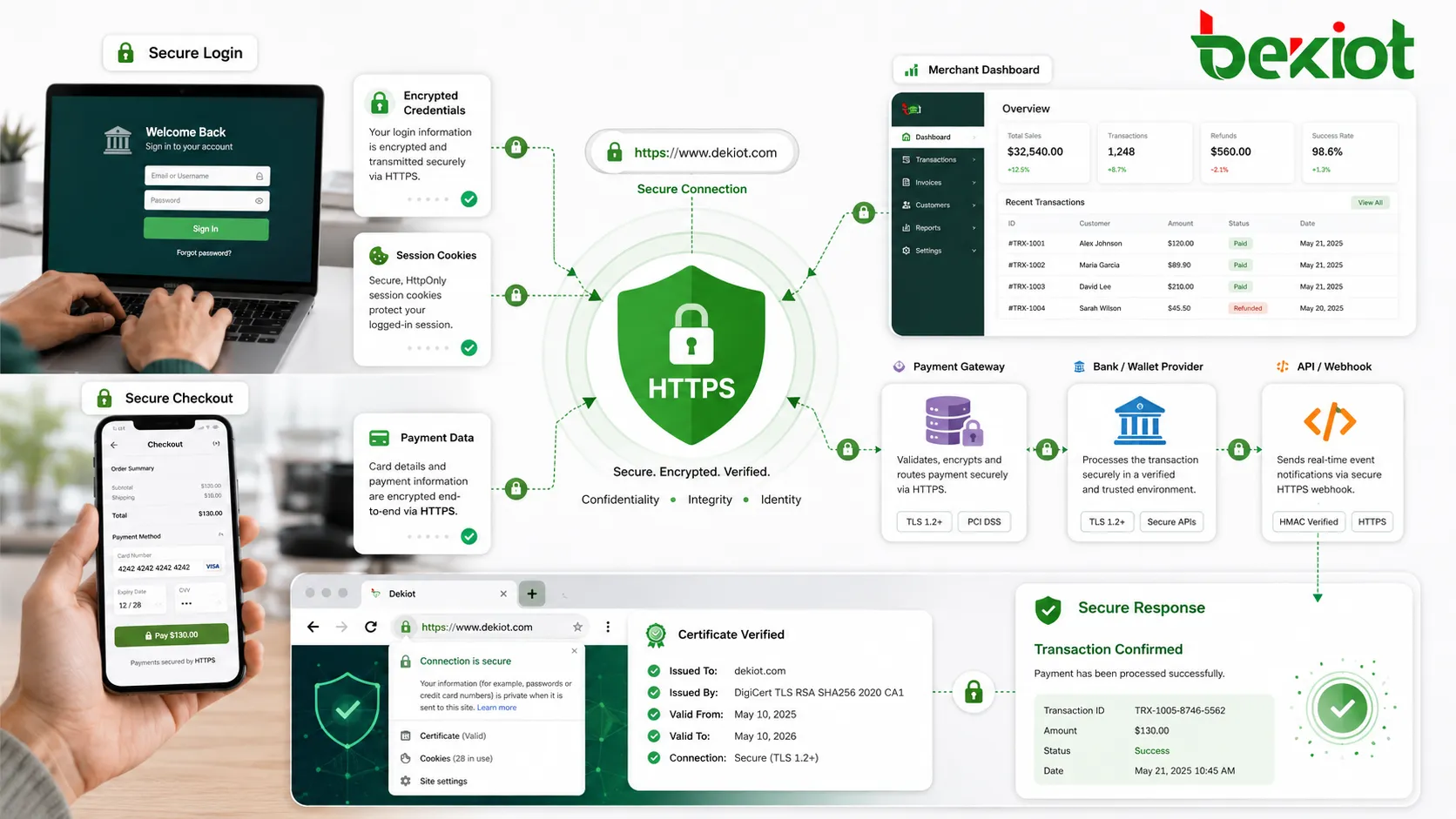
Payment pages, online banking, billing platforms, subscription systems, invoice portals, and financial dashboards are obvious HTTPS use cases. They involve information such as card data, account records, transaction details, billing addresses, authorization codes, receipts, and user identity. These values require both confidentiality and integrity.
Encryption protects payment information while it travels between the client and server. Identity verification helps the user avoid sending financial information to an impersonated site. Integrity protection helps prevent transaction data from being altered during transmission. Together, these properties make HTTPS a basic requirement for trusted financial interaction.
Payment workflows may include multiple parties: the merchant site, payment gateway, bank, wallet provider, anti-fraud platform, callback endpoint, and user browser or mobile app. HTTPS is needed not only on the visible checkout page but also on background callbacks, payment confirmation APIs, webhook endpoints, and merchant dashboards.
It is important to note that HTTPS does not by itself make a payment system fully compliant or secure. Payment security also requires proper application design, data minimization, tokenization, access control, fraud monitoring, secure storage, logging, and compliance with relevant payment requirements. HTTPS protects the transport channel; it does not replace the full security architecture.
Special use in APIs and service-to-service communication
HTTPS is not only for web pages viewed by humans. Many modern systems communicate through APIs using HTTPS. Mobile apps, web front ends, cloud services, microservices, partner systems, management platforms, and automation tools often exchange JSON, XML, files, commands, tokens, and status data through HTTPS endpoints.
For APIs, HTTPS protects access tokens, request bodies, response data, and authentication headers. Without HTTPS, a bearer token or API key transmitted in plain text could be captured and used by an attacker. Because many API credentials act like access passes, transport protection is essential.
Service-to-service communication often runs inside private networks, but private does not always mean safe. Internal networks can contain compromised hosts, misconfigured monitoring tools, shared infrastructure, or untrusted segments. Using HTTPS between services reduces the assumption that the internal network is fully trusted.
In more advanced environments, APIs may use mutual TLS. In ordinary HTTPS, the client usually verifies the server certificate. In mutual TLS, the server also verifies a client certificate. This can be used to authenticate devices, services, gateways, or partners at the transport layer. It is especially useful where API access must be restricted to known systems rather than only username-password or token-based logic.
API gateways and reverse proxies often terminate HTTPS at the edge and then forward requests to internal services. This can simplify certificate management and traffic control, but it also requires careful design. If traffic from the proxy to internal services is unencrypted, the internal path must be trusted and protected. In high-security environments, end-to-end or re-encrypted internal HTTPS may be required.
Special use in cloud platforms and management consoles
Cloud platforms depend heavily on HTTPS because users manage infrastructure through web consoles, APIs, and automation tools. A cloud dashboard may allow users to create servers, manage databases, download keys, change firewall rules, view logs, configure storage, and control identity permissions. These actions are highly sensitive.
HTTPS protects the management session between the administrator and the cloud platform. It reduces the risk of credential theft, session hijacking, command manipulation, and sensitive data exposure. If management traffic were unprotected, an attacker could potentially observe or interfere with infrastructure operations.
Cloud APIs also use HTTPS as the basic transport for automation. Infrastructure-as-code tools, deployment scripts, monitoring agents, backup systems, and orchestration platforms may all call HTTPS endpoints. These requests can create or destroy resources, rotate secrets, modify network policies, or retrieve logs. Transport security is therefore essential for operational safety.
Cloud environments also illustrate the need for correct certificate and domain management. Services may use custom domains, load balancers, CDN endpoints, wildcard certificates, regional endpoints, and internal service names. Each endpoint should be covered by suitable certificate configuration and renewal processes. A certificate failure on a management endpoint can interrupt operations even if the underlying service is healthy.
Special use in IoT, devices, and remote terminals
IoT devices and remote terminals often use HTTPS to communicate with cloud platforms, management servers, update services, or monitoring systems. These devices may be installed in homes, factories, vehicles, utility stations, buildings, outdoor locations, or distributed infrastructure. Many of them operate across networks that cannot be fully controlled by the device owner.
HTTPS helps protect telemetry data, configuration commands, firmware update requests, authentication tokens, and device registration processes. If a device sends status data or receives commands without protection, an attacker may intercept information or attempt to manipulate device behavior.
Device identity is a special challenge. Some deployments rely on server-side HTTPS only, where the device verifies the server before sending data. More secure deployments may use client certificates, device-bound credentials, secure elements, or mutual TLS to verify that the device itself is authorized. The correct approach depends on device value, deployment scale, risk level, and maintenance capability.
Firmware update delivery is a particularly important special application. HTTPS can protect the transport path between the update server and the device, reducing the risk that an update package is replaced in transit. However, secure update design should also include package signing and verification on the device side. Transport security and software authenticity should work together.
Remote device management also depends on stable certificate handling. Devices may have limited memory, long lifecycles, intermittent connectivity, and difficult physical access. Certificate expiration, time synchronization errors, root certificate changes, and renewal failures can cause large-scale connection problems if not planned carefully.
Special use in industrial and operational systems
Industrial and operational systems increasingly use web interfaces for monitoring, configuration, dashboards, logs, alarms, reporting, and remote maintenance. These systems may include controllers, gateways, network devices, communication platforms, sensors, power systems, building systems, and security equipment. Many of them expose an HTTPS management interface.
The use of HTTPS in these environments is not only about privacy. It is about preventing unauthorized observation and modification of operational settings. A configuration page may include network parameters, user accounts, alarm thresholds, routing rules, firmware controls, or system logs. If such traffic is exposed, the risk can affect equipment behavior and site operation.
Industrial environments often have older devices and long replacement cycles. Some devices may support only limited TLS versions or outdated certificate handling. This creates a practical challenge: organizations want encrypted management, but they must also maintain compatibility with legacy devices. A secure transition plan may include network segmentation, proxy gateways, controlled access paths, firmware updates, and gradual replacement.
Remote maintenance is another special application. Engineers may access dashboards, diagnostic pages, logs, or configuration portals from outside the local site. HTTPS is a necessary foundation for protecting that access, but it should be combined with VPN, strong authentication, role-based permission, audit logging, and restricted exposure. Exposing a management interface to the internet with only a password is usually not enough.
Special use in content delivery and edge platforms
Content delivery networks and edge platforms use HTTPS to deliver websites, media files, scripts, images, downloads, and application data from locations close to users. In this architecture, HTTPS may be terminated at the edge node, while the edge node communicates with the origin server through another connection.
Edge HTTPS improves user trust and protects content delivery across public networks. It also enables modern browser features and reduces mixed-content problems. For websites with global users, CDN-based HTTPS can improve availability and performance while keeping secure access at the user-facing layer.
The relationship between edge and origin must be designed carefully. If the browser-to-edge path is encrypted but the edge-to-origin path is not protected, sensitive data may still be exposed inside the backend path. Many deployments therefore use HTTPS both from client to edge and from edge to origin.
Certificate management at the edge can become complex because a single platform may serve many custom domains. Automation, renewal monitoring, domain validation, and correct certificate mapping are important. A mistake can cause browser warnings or service disruption even if the website content itself is available.
Special use in mobile applications and public networks
Mobile applications rely heavily on HTTPS because users often connect through cellular networks, public Wi-Fi, home routers, office networks, hotels, airports, cafes, and shared hotspots. The application developer cannot assume that the network is trustworthy. HTTPS provides a secure channel between the app and its backend service.
Mobile apps usually exchange login data, user profiles, location information, push token registration, payment requests, device identifiers, messages, media uploads, and API responses. Even when the app interface looks simple, the data behind it may be sensitive. HTTPS reduces exposure across unpredictable network environments.
Certificate validation is especially important in mobile apps. An app should not ignore certificate errors or accept any certificate without verification. Some high-security apps may use certificate pinning or public key pinning strategies, although these must be managed carefully to avoid service outages when certificates change.
Public networks also increase the risk of captive portals, fake hotspots, local interception, and traffic manipulation. HTTPS cannot prevent a user from joining a malicious network, but it can prevent that network from reading or changing protected application traffic when certificate verification is working correctly.
Performance, HTTP/2, and HTTP/3 considerations
Some people still assume that HTTPS is always slow because encryption adds overhead. In early environments, that concern was more visible. Modern hardware, optimized TLS libraries, session resumption, HTTP/2 multiplexing, and HTTP/3 over QUIC have changed the practical performance picture. For many sites, HTTPS performance is not a major bottleneck when properly configured.
HTTP/2 commonly runs over TLS in browsers and improves efficiency through multiplexing, header compression, and better use of persistent connections. This can reduce the number of separate connections needed for a page with many resources. HTTPS therefore became not only a security requirement but also part of the path to modern web performance.
HTTP/3 uses QUIC, which integrates encryption more deeply and runs over UDP. It is designed to improve connection establishment, reduce some head-of-line blocking problems, and support better behavior under certain network conditions. In practice, deployment depends on server support, CDN support, firewall behavior, browser support, and network conditions.
Performance still requires good configuration. A server should avoid unnecessary redirects, use reasonable certificate chains, enable session resumption where appropriate, configure modern protocols, and monitor handshake time, time to first byte, and error rates. Encryption alone does not create performance problems; poor deployment often does.

Deployment rules that affect real security
The first rule is to use a valid certificate for the correct domain. The certificate must cover the domain names users or clients actually access. If users connect through www, bare domain, subdomain, API domain, or regional endpoint, certificate coverage should match. Misalignment causes browser warnings and failed client connections.
The second rule is to protect the private key. If the private key is stolen, an attacker may impersonate the server in certain scenarios or compromise trust. Private keys should be stored securely, access should be restricted, and operational processes should avoid copying keys unnecessarily across unmanaged systems.
The third rule is to disable obsolete protocols and weak cipher suites. Compatibility with very old clients may seem convenient, but it can expose the service to known weaknesses. Organizations should review their user base and security requirements before allowing outdated options.
The fourth rule is to redirect HTTP to HTTPS correctly. Many websites still receive requests through plain HTTP because users type the domain without a scheme or old links point to HTTP. Redirects should send users to the HTTPS version. For stronger protection, HTTP Strict Transport Security can tell browsers to use HTTPS automatically for future connections.
The fifth rule is to avoid mixed content. If an HTTPS page loads scripts, images, frames, or resources through plain HTTP, the page may become less secure or may be blocked by browsers. Active mixed content such as scripts is especially dangerous because it can undermine the security of the protected page.
The sixth rule is to monitor certificate expiration and renewal. Expired certificates are a common cause of avoidable outages. Automation can help, but automated systems still need monitoring. Domain validation failures, DNS problems, rate limits, file permission errors, or load balancer misconfiguration can break renewal unexpectedly.
Common configuration mistakes
One common mistake is treating HTTPS as complete after installing a certificate. The certificate is only one part. The server must also support secure protocol versions, correct cipher configuration, proper redirect behavior, secure cookies, safe headers, and reliable renewal. A padlock alone does not prove that every layer is well configured.
Another mistake is leaving internal services unprotected because they are “not public.” Internal systems may still carry sensitive credentials, tokens, configuration data, and operational commands. If users, scripts, or services communicate over shared networks, HTTPS or another secure transport should be considered.
A third mistake is ignoring application-level security. HTTPS protects data in transit, but it does not prevent SQL injection, cross-site scripting, weak passwords, broken access control, insecure file uploads, or server-side data leaks. A site can use HTTPS and still be vulnerable if the application is poorly designed.
Improper reverse proxy configuration is also common. A backend application may not know that the original request was HTTPS after traffic is terminated at a proxy. This can cause wrong redirects, insecure cookie settings, incorrect URL generation, or mixed-content problems. Forwarded headers and trust boundaries must be configured carefully.
Certificate chain errors can also cause problems. A server may install the main certificate but omit intermediate certificates. Some clients may still work because they can fetch missing intermediates, while others may fail. A complete certificate chain should be configured and tested across different client types.
How to judge whether the configuration is reliable
A reliable HTTPS deployment should pass several practical checks. The certificate should match the domain, the chain should be valid, the certificate should not be expired, and renewal should be monitored. The server should prefer modern TLS versions and avoid weak algorithms. HTTP requests should be redirected correctly to HTTPS.
The application should use secure cookies for session identifiers. Login pages, payment pages, account pages, APIs, downloads, and management pages should all use HTTPS. Sensitive resources should not be loaded through plain HTTP. Security headers should be considered according to the application type.
The deployment should also be tested from the perspective of real clients. A browser, mobile app, API client, embedded device, or industrial terminal may not behave the same way. Some devices have older trust stores or limited TLS support. Testing should include representative clients rather than only the administrator’s browser.
Operational reliability matters as much as initial setup. Certificate renewal should be automated or scheduled. Expiration alerts should be sent early enough for action. Key rotation, server migration, domain changes, CDN changes, load balancer updates, and disaster recovery plans should all include HTTPS considerations.
Wrap-up
HTTPS works by placing HTTP communication inside a TLS-protected channel. Before the actual web request is exchanged, the client and server perform a handshake, verify certificates, negotiate secure parameters, create session keys, and then protect application data through encryption and integrity checks. This allows users and systems to communicate more safely across networks that should not be blindly trusted.
Its value is not limited to ordinary websites. HTTPS is essential for login systems, payment platforms, APIs, cloud consoles, mobile apps, IoT devices, industrial management interfaces, CDN delivery, remote maintenance, and service-to-service communication. In each case, it protects identity, data, commands, tokens, sessions, and operational information while reducing the risk of interception or tampering.
The strongest HTTPS deployments combine correct certificates, secure protocol configuration, protected private keys, safe application design, reliable renewal, and continuous monitoring. HTTPS is not a decorative browser symbol. It is a core security layer for modern digital communication.
FAQ
Is HTTPS the same as TLS?
No. HTTPS is HTTP running over a secure TLS channel. TLS is the security protocol that provides encryption, authentication, and integrity protection. HTTPS uses TLS to protect web requests and responses.
Does HTTPS hide the website domain from everyone?
Not completely. HTTPS protects the content of requests and responses, but network observers may still see information such as the server IP address and, in many cases, domain-related connection information. HTTPS is transport security, not full anonymity.
Why does a website still need HTTPS if it has no payment page?
Even non-payment websites may contain login forms, cookies, contact forms, search queries, downloads, account data, or user behavior information. HTTPS also prevents content tampering and supports modern browser features.
Can HTTPS protect a poorly designed application?
HTTPS protects data in transit, but it does not fix application vulnerabilities. Problems such as weak passwords, broken access control, SQL injection, cross-site scripting, insecure storage, or exposed admin pages still need separate security controls.
Why do certificate expiration problems cause service outages?
When a certificate expires, clients may no longer trust the server identity. Browsers, apps, APIs, and devices may block the connection or show security errors. This is why certificate renewal and monitoring are essential operational tasks.