

What Is Sound Pressure Level (SPL)? What Are Its Audio Advantages?
Sound Pressure Level, commonly abbreviated as SPL, is a measurement that describes the pressure variation created by a sound wave in air. When a speaker, horn, alarm, voice announcement, machine, or musical instrument produces sound, it creates tiny changes in air pressure. SPL expresses those pressure changes in decibels, usually written as dB SPL.
In practical audio work, SPL is used to describe how strong or loud a sound is at a specific location. It helps engineers, installers, safety managers, acoustic consultants, and sound system designers evaluate whether a sound source can be heard clearly, whether a loudspeaker covers the intended area, whether an alarm is strong enough, and whether noise exposure may become unsafe.
SPL is widely used in public address systems, emergency broadcasting, industrial warning systems, voice alarm systems, concert sound reinforcement, classrooms, conference rooms, factories, transportation facilities, offices, hospitals, airports, tunnels, and outdoor announcement systems. It is one of the most important audio measurements because sound performance cannot be judged only by amplifier power or speaker size. What matters at the listener position is the actual sound pressure level.
What Is Sound Pressure Level?
Definition and Core Meaning
Sound Pressure Level is the logarithmic expression of sound pressure compared with a reference pressure. In air, the common reference pressure is 20 micropascals, which is approximately the threshold of human hearing at 1 kHz for a young listener with healthy hearing. Because sound pressure can vary over a huge range, SPL is expressed in decibels rather than ordinary linear units.
The core meaning of SPL is acoustic strength at a measurement point. A speaker may have a certain power rating, but the SPL at a listener’s position depends on speaker sensitivity, input power, distance, room acoustics, directionality, background noise, mounting position, and environmental conditions.
This is why SPL is more useful than power rating alone when evaluating actual sound results. A 100-watt amplifier does not automatically guarantee clear sound in every area. The measured or predicted SPL tells whether the sound energy is reaching the intended listening zone.
SPL measures the sound pressure that actually exists at a location, not simply the electrical power supplied to a loudspeaker.
Why SPL Uses Decibels
SPL uses decibels because human hearing covers a very large pressure range. The quietest audible sound is extremely small, while loud industrial noise, alarms, aircraft, sirens, or concert systems can produce much higher pressure levels. A linear scale would be inconvenient for describing such a wide range.
The decibel scale compresses this range into more manageable numbers. For example, a quiet room, normal conversation, busy traffic, industrial machinery, and emergency alarms can all be compared using dB SPL values. This makes SPL practical for audio design, noise assessment, and sound system commissioning.
However, the decibel scale is logarithmic, so it should not be interpreted like a simple percentage or linear number. A small increase in dB can represent a meaningful change in acoustic energy.

How SPL Works
Sound Pressure and Air Movement
Sound travels through air as pressure waves. When a sound source vibrates, it compresses and rarefies the air around it. These pressure variations move outward from the source and can be detected by the human ear, a microphone, or a sound level meter.
SPL represents the magnitude of those pressure variations. A higher SPL means stronger pressure variation. A lower SPL means weaker pressure variation. In most everyday situations, people perceive higher SPL as louder sound, although perceived loudness is also affected by frequency, duration, hearing sensitivity, and background noise.
In audio systems, SPL can be predicted and measured to evaluate whether a loudspeaker or alarm device can provide sufficient sound pressure at the intended listening distance.
Distance and Sound Reduction
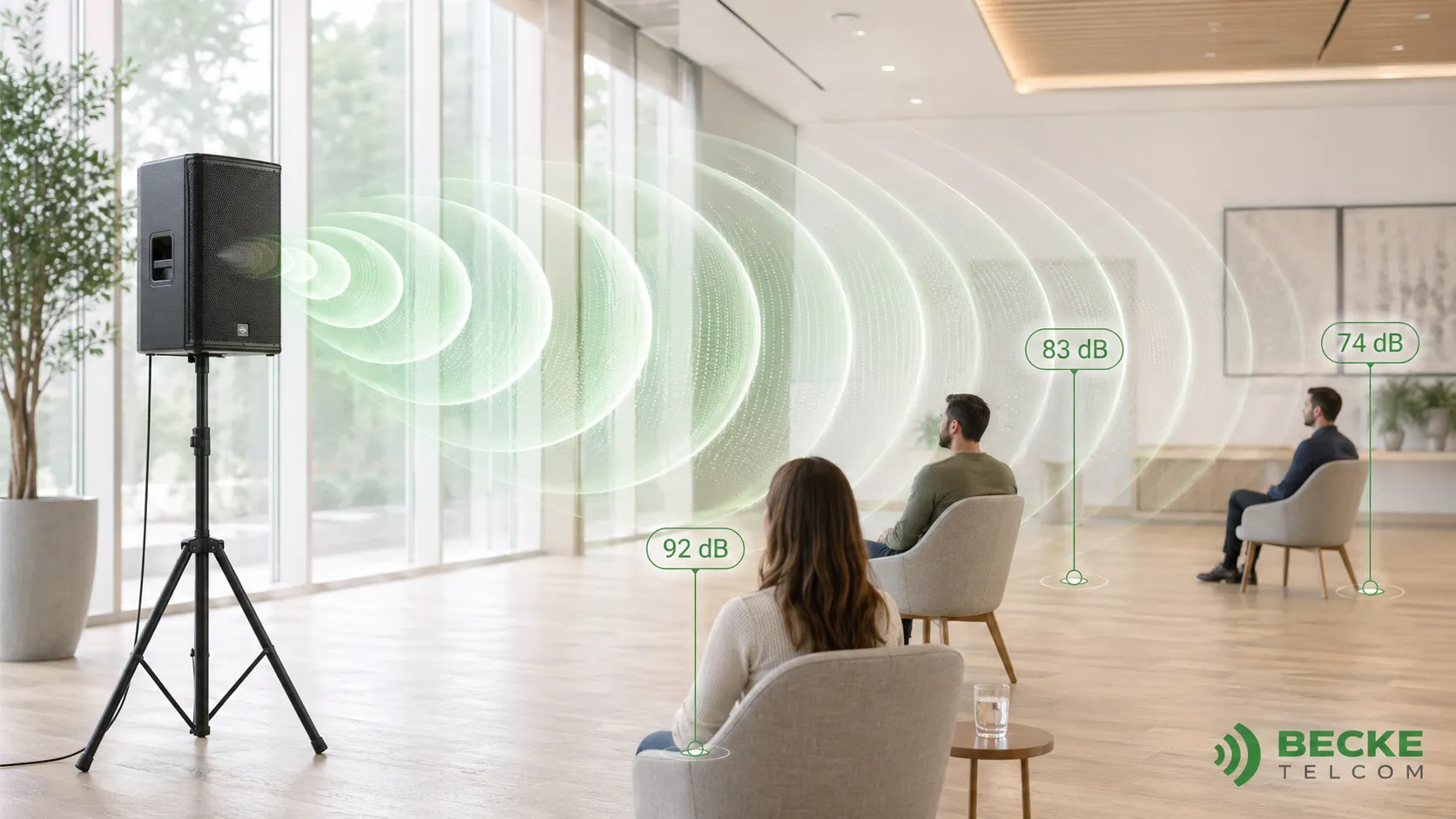
SPL normally decreases as distance from the sound source increases. In a free-field environment, sound pressure level from a point source typically drops by about 6 dB each time the distance doubles. This is a useful rule for estimating coverage, although real rooms and outdoor environments may differ because of reflections, absorption, obstacles, wind, and speaker directivity.
For example, a loudspeaker may produce a high SPL at one meter, but listeners farther away will receive a lower level. This is why speaker placement, horn direction, amplifier power, speaker sensitivity, and system zoning are important in public address and emergency audio systems.
A sound system should be designed based on the required SPL at the listener location, not only the rated SPL near the speaker.
SPL, Frequency, and Weighting
SPL can be measured across different frequency ranges. Human hearing is not equally sensitive to all frequencies, so sound level meters often use frequency weighting. The most common weighting for general noise and environmental measurement is A-weighting, written as dB(A). It adjusts the measurement to approximate human hearing sensitivity at moderate sound levels.
C-weighting, written as dB(C), is often used when low-frequency content and high-level sound are important. Z-weighting, or flat weighting, measures sound with minimal frequency weighting across the instrument’s supported range.
The weighting method should always be stated when reporting sound levels. A value in dB SPL, dB(A), and dB(C) may not describe exactly the same measurement condition.
SPL values are most useful when the measurement position, distance, frequency weighting, and operating condition are clearly defined.
SPL and Loudness
Difference Between SPL and Perceived Loudness
SPL and perceived loudness are related, but they are not the same. SPL is a physical measurement of sound pressure. Loudness is a human perception of how strong or intense a sound seems. Two sounds with the same SPL may not seem equally loud if their frequency content is different.
Human ears are generally more sensitive to mid-frequency sounds than to very low or very high frequencies. This means a mid-frequency tone and a low-frequency rumble may have the same measured SPL but different perceived loudness. Duration also matters; a short sound and a continuous sound may be experienced differently.
In audio design, SPL provides an objective measurement, while loudness describes user experience. Good sound system design should consider both.
Why More SPL Is Not Always Better
Higher SPL can help sound reach a larger area or overcome background noise, but more SPL is not always better. Excessive sound pressure can cause discomfort, reduce speech intelligibility, create listener fatigue, disturb nearby areas, or exceed safety limits.
For voice announcements, the goal is not maximum loudness. The goal is clear and understandable speech at the listener position. A system that is too loud may produce distortion, echo, reflections, or harshness, especially in reverberant spaces such as stations, factories, halls, tunnels, and warehouses.
The right SPL depends on the application, background noise, listening distance, room acoustics, and safety requirements.

How SPL Is Measured
Sound Level Meter
SPL is commonly measured with a sound level meter. The meter uses a calibrated microphone to capture sound pressure and displays the result in decibels. Professional meters may allow different frequency weightings, time weightings, logging functions, octave-band analysis, and calibration checks.
The measurement position matters. A meter placed close to a loudspeaker will show a higher reading than a meter placed far away. A meter near a wall may capture reflections. A meter in a noisy area may include background sound. Therefore, SPL measurement should always specify where and how the reading was taken.
For reliable results, the meter should be calibrated, and the measurement should follow a consistent procedure.
Measurement Conditions
SPL measurement conditions include distance from the sound source, microphone height, direction of measurement, background noise, frequency weighting, time weighting, test signal, source power, and environmental conditions. Without these details, two SPL readings may not be directly comparable.
Speaker specifications often list sensitivity as an SPL value measured at one watt input at one meter distance, such as 1 W/1 m. This is useful for comparing speaker efficiency. However, actual site performance may be very different because real installations include distance, room reflections, mounting height, cabling, amplifier limits, and noise conditions.
For installed audio systems, field measurement is often needed to confirm whether design goals are actually achieved.
Peak, Average, and Continuous Levels
SPL may be reported in different ways. Instantaneous or peak levels show short-term maximum sound pressure. Average levels describe sound energy over a defined period. Continuous equivalent level, often used in noise assessment, represents a time-averaged sound level.
These values serve different purposes. A peak alarm sound may be important for warning design. An average noise level may be important for workplace exposure. A steady public address level may be important for speech coverage.
When reviewing SPL data, it is important to know whether the value represents peak, maximum, average, or continuous equivalent sound level.
Audio Advantages of SPL
Objective Audio Performance Evaluation
One major audio advantage of SPL is that it provides an objective way to evaluate sound output. Instead of relying only on subjective impressions such as “loud enough” or “too quiet,” engineers can measure or calculate the sound pressure level at specific locations.
This is especially useful when designing sound systems for large or complex spaces. A public address system, emergency broadcast system, classroom audio system, meeting room, factory announcement system, or outdoor speaker network must provide suitable sound levels across the intended coverage area.
SPL measurement helps convert audio performance into a measurable target, making design, testing, and acceptance more reliable.
Better Coverage Planning
SPL helps designers plan speaker coverage. By estimating how sound level changes with distance and direction, designers can decide how many speakers are needed, where they should be placed, what power level is required, and how zones should be arranged.
This is important because uneven sound coverage creates problems. Some listeners may not hear announcements clearly, while others may be exposed to excessive levels. SPL planning helps reduce these differences and supports more consistent audio across the space.
In public address and emergency communication systems, good coverage planning improves both usability and safety.
Improved Speech Intelligibility
Speech intelligibility depends partly on the relationship between voice level and background noise. If the SPL of the announcement is too low compared with ambient noise, listeners may hear sound but fail to understand the message. If the SPL is too high, distortion and reflections may reduce clarity.
By measuring background noise and target announcement level, designers can set a suitable signal-to-noise relationship. This helps voice announcements, paging messages, evacuation instructions, and operator calls remain understandable.
SPL does not measure speech intelligibility by itself, but it is a key input for achieving intelligible voice communication.
SPL is valuable because it helps audio systems deliver sound that is not only loud, but also usable, balanced, and understandable.
SPL in Speaker and Audio System Design
Speaker Sensitivity
Speaker sensitivity is often expressed as an SPL value at a defined input and distance, commonly 1 watt at 1 meter. A higher sensitivity speaker produces more sound pressure from the same amplifier power than a lower sensitivity speaker. This is an important specification when comparing loudspeakers.
For example, a speaker with higher sensitivity may require less amplifier power to reach the same SPL at a given distance. This can reduce amplifier load, improve efficiency, and support larger system design. However, sensitivity is only one factor. Frequency response, directivity, distortion, durability, and application suitability also matter.
SPL helps explain why two speakers with the same wattage rating may produce very different acoustic output.
Amplifier Power and Acoustic Output
Amplifier power affects SPL, but the relationship is logarithmic. Increasing amplifier power does not increase perceived loudness in a simple linear way. In general, doubling amplifier power increases SPL by about 3 dB if the speaker remains within its operating limits and no compression or distortion occurs.
This means that a large increase in electrical power may produce only a moderate increase in sound level. System designers should therefore avoid assuming that more wattage alone will solve coverage problems. Speaker placement, sensitivity, directivity, and acoustic environment may be more important.
SPL-based design helps balance amplifier power with real acoustic performance.
Directivity and Sound Focus
Speaker directivity describes how sound is distributed in different directions. A horn speaker may project sound strongly in a defined direction, while a ceiling speaker may distribute sound more broadly. SPL varies depending on direction and listening position.
Directivity affects coverage, clarity, and noise control. In a noisy factory or outdoor area, directional speakers can focus sound toward the audience and reduce unnecessary spill. In a room, wide coverage may be preferred for even listening.
SPL measurement across different positions helps verify whether the speaker pattern matches the application.

SPL and Background Noise
Signal-to-Noise Relationship
Background noise is one of the biggest factors affecting audio performance. A paging message in a quiet office requires much less SPL than the same message in a factory, subway platform, warehouse, or machinery room. If background noise is high, the announcement level must be high enough to be heard and understood.
The relationship between desired sound and background noise is often called the signal-to-noise ratio. A voice announcement needs a suitable margin above ambient noise to remain intelligible. The required margin depends on the type of message, acoustic environment, listener attention, and safety requirements.
SPL measurement allows designers to compare ambient noise and system output instead of guessing.
Noise Masking and Clarity
Noise masking occurs when background noise covers or hides important parts of a sound. In speech communication, masking can make consonants difficult to hear, which reduces understanding even if the voice seems loud enough. Machines, fans, traffic, crowds, ventilation systems, and reverberation can all contribute to masking.
SPL planning helps reduce masking by ensuring enough voice level at the listener position. However, the solution is not always simply adding more volume. Better speaker placement, more zones, directional speakers, acoustic treatment, and noise control may produce better clarity.
A well-designed system uses SPL as one part of a broader clarity strategy.
SPL in Public Address and Emergency Audio
Public Address Systems
Public address systems use SPL planning to deliver announcements across offices, campuses, factories, stations, shopping centers, hotels, and public facilities. The system must provide enough level for listeners to hear messages clearly without making the environment uncomfortable.
SPL helps determine speaker spacing, amplifier sizing, zone design, and volume settings. It also helps installers test whether the system meets the expected coverage level after installation.
A public address system that is properly planned around SPL can provide more consistent and reliable communication.
Emergency Broadcasting and Voice Alarm
Emergency broadcasting and voice alarm systems rely on clear, audible instructions. In these systems, SPL can directly affect safety. If messages are too quiet, people may miss instructions. If messages are too loud or distorted, people may not understand them.
SPL must be considered together with speech intelligibility, background noise, evacuation routes, room acoustics, speaker placement, and system reliability. Emergency messages should be audible in the intended zones while avoiding unnecessary discomfort or confusion.
In emergency audio, the goal is not just to generate high SPL. The goal is to deliver clear instructions at the right level to the right area.
Industrial Paging and Warning Systems
Industrial paging and warning systems often operate in high-noise environments. Factories, power plants, refineries, mines, workshops, ports, and warehouses may have machinery, ventilation, vehicles, and process noise that make announcements difficult to hear.
SPL measurement helps determine whether horn speakers, column speakers, ceiling speakers, or local sounders can overcome background noise. It also helps decide whether more speakers, directional coverage, zone control, or local visual alarms are needed.
In industrial environments, SPL supports practical communication performance and worker awareness.
Applications of SPL Measurement
Speaker Selection and System Commissioning
SPL measurement is useful when selecting speakers and commissioning sound systems. Designers can use speaker sensitivity, maximum SPL, directivity, and power handling to choose suitable products. After installation, field measurements can confirm whether the system delivers the expected level.
Commissioning may include measuring SPL at different listener locations, checking zone balance, adjusting amplifier output, testing emergency messages, and verifying that coverage is not too weak or too excessive.
This process helps turn design assumptions into verified performance.
Workplace Noise Assessment
SPL is also used for workplace noise assessment. Industrial noise, machinery, tools, vehicles, and ventilation systems can produce levels that affect hearing health and communication. Measuring SPL helps safety teams identify noisy areas and determine whether hearing protection, noise control, or operational changes are needed.
Workplace noise assessment often uses time-weighted measurements and A-weighted sound levels. The goal is different from speaker design, but the basic concept of sound pressure measurement remains the same.
In noisy workplaces, SPL data helps balance safety, communication, and operational awareness.
Room Acoustics and Audio Tuning
In rooms, SPL is affected by reflections, absorption, reverberation, and speaker placement. A room may have areas where sound is too strong and other areas where sound is too weak. Measuring SPL at multiple points helps identify uneven coverage.
Audio tuning may involve adjusting speaker levels, delay, equalization, orientation, or zone layout. SPL measurement provides a practical starting point for these adjustments.
For classrooms, meeting rooms, houses of worship, auditoriums, and public facilities, SPL measurement helps improve listening comfort and clarity.

Key Factors That Affect SPL
Speaker Output and Sensitivity
Speaker output and sensitivity strongly affect SPL. A speaker with higher sensitivity can produce more sound pressure with the same input power. A speaker designed for long-throw outdoor projection may produce a different SPL pattern than a small indoor ceiling speaker.
The correct speaker depends on the application. A quiet office, noisy workshop, outdoor yard, tunnel, classroom, and warehouse may each require different speaker types and output levels.
SPL helps compare these choices based on expected acoustic performance rather than appearance alone.
Distance, Obstacles, and Room Acoustics
Distance reduces SPL, and obstacles can block or scatter sound. Walls, columns, machines, shelves, vehicles, glass, curtains, and people all affect sound propagation. Room acoustics can either support or damage clarity depending on reverberation and reflections.
In a highly reflective space, increasing SPL may make sound louder but not clearer. In an absorptive space, more speaker output or closer spacing may be required. Outdoor areas may be affected by wind, temperature gradients, and background noise.
These factors explain why field testing is important for many audio installations.
Background Noise and Operating Conditions
Background noise changes throughout the day in many environments. A factory may be quiet during maintenance but loud during production. A station may be quiet at night but noisy during peak traffic. A warehouse may change noise level when vehicles, conveyors, or ventilation systems are active.
SPL design should consider the actual operating condition, not only the quietest moment. If the system is designed using unrealistically low background noise, it may fail when the environment becomes busy.
For critical announcements, designers should evaluate the expected worst-case noise condition.
Common SPL Misunderstandings
SPL Is Not the Same as Wattage
A common misunderstanding is treating speaker wattage as the same as loudness. Wattage describes electrical power handling or amplifier output. SPL describes acoustic pressure at a location. A high-watt speaker may not be louder than a lower-watt speaker if its sensitivity is lower or if it is installed poorly.
For real audio performance, wattage, sensitivity, distance, directivity, distortion, and environment must be considered together.
SPL is the measurement that connects these factors to what listeners actually receive.
Maximum SPL Is Not Normal Operating SPL
Speaker specifications may list maximum SPL, but this does not necessarily mean the system should operate continuously at that level. Maximum SPL may be measured under specific test conditions and may involve distortion limits, short-term power, or ideal placement.
Normal operating SPL should be chosen based on comfort, clarity, safety, and system headroom. Running a system too close to its maximum capability can increase distortion and reduce reliability.
Good design provides enough SPL with margin, rather than forcing equipment to operate at its limit.
Higher SPL Does Not Guarantee Clearer Speech
Higher SPL can help overcome noise, but it does not automatically make speech clearer. If a room has long reverberation, poor speaker placement, strong echoes, or distorted audio, increasing volume may make speech louder but less intelligible.
Clear speech requires a suitable SPL, good speaker placement, controlled reverberation, proper equalization, enough signal-to-noise ratio, and low distortion.
SPL is essential, but it should be used together with speech intelligibility and acoustic design principles.
Maintenance and Testing Tips
Measure at Real Listener Positions
SPL should be measured where people actually listen, work, walk, or respond to messages. Measuring only near the speaker can produce misleading results. The listener position may be much farther away, partially blocked, or exposed to higher background noise.
In public address and emergency audio systems, measurements should cover representative points across the intended zone. This helps identify weak spots, excessive areas, and uneven coverage.
Real-position measurement is one of the simplest ways to make SPL data useful.
Test Under Real Operating Noise
Audio systems should be tested under realistic background noise conditions. A system that sounds clear during an empty-site test may not be clear when machinery, crowds, vehicles, ventilation, or production processes are active.
Testing under real operating noise helps confirm whether announcements can be heard and understood when the system is actually needed. This is especially important for industrial paging, transportation announcements, emergency broadcasting, and public facilities.
If testing under full operating noise is not possible, designers should use conservative assumptions and verify later during operation.
Document SPL Results
SPL measurements should be documented with location, date, meter type, calibration status, weighting, time setting, test signal, background noise condition, and system volume setting. Good documentation helps future maintenance teams understand the system baseline.
If users later complain that a zone is too quiet or too loud, documented SPL data can help determine whether the system changed or whether the original design needs adjustment.
Documentation turns SPL measurement into a useful long-term maintenance tool.
Conclusion
Sound Pressure Level, or SPL, is a decibel-based measurement of acoustic pressure at a specific location. It is used to evaluate how strong a sound is, how far a loudspeaker can project, whether an announcement is audible, and whether a noise source may create safety or comfort concerns.
The audio advantages of SPL include objective performance evaluation, better speaker coverage planning, improved speech intelligibility, more accurate system commissioning, better background noise comparison, and safer sound level management. SPL helps designers and operators move beyond guesswork and make sound systems measurable.
In public address, emergency broadcasting, industrial paging, speaker design, workplace noise assessment, room acoustics, and communication systems, SPL is one of the most important indicators of real-world audio performance. The best results come from balancing sufficient sound pressure with clarity, comfort, intelligibility, and environmental suitability.
FAQ
What is SPL in simple terms?
SPL, or Sound Pressure Level, measures how strong a sound wave is at a specific location. It is expressed in decibels and is commonly written as dB SPL.
In simple terms, it helps describe how loud or powerful a sound is at the listening point.
Is SPL the same as loudness?
No. SPL is a physical measurement of sound pressure, while loudness is how humans perceive sound. They are related, but frequency, duration, hearing sensitivity, and background noise can make sounds with the same SPL seem different in loudness.
SPL is objective, while loudness is perceptual.
Why is SPL important in audio systems?
SPL is important because it helps determine whether sound reaches listeners at the right level. It supports speaker selection, amplifier planning, coverage design, speech intelligibility, alarm audibility, and noise safety assessment.
It is one of the key measurements used to verify real audio performance after installation.