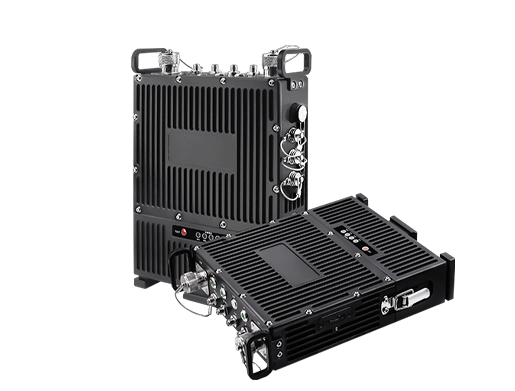


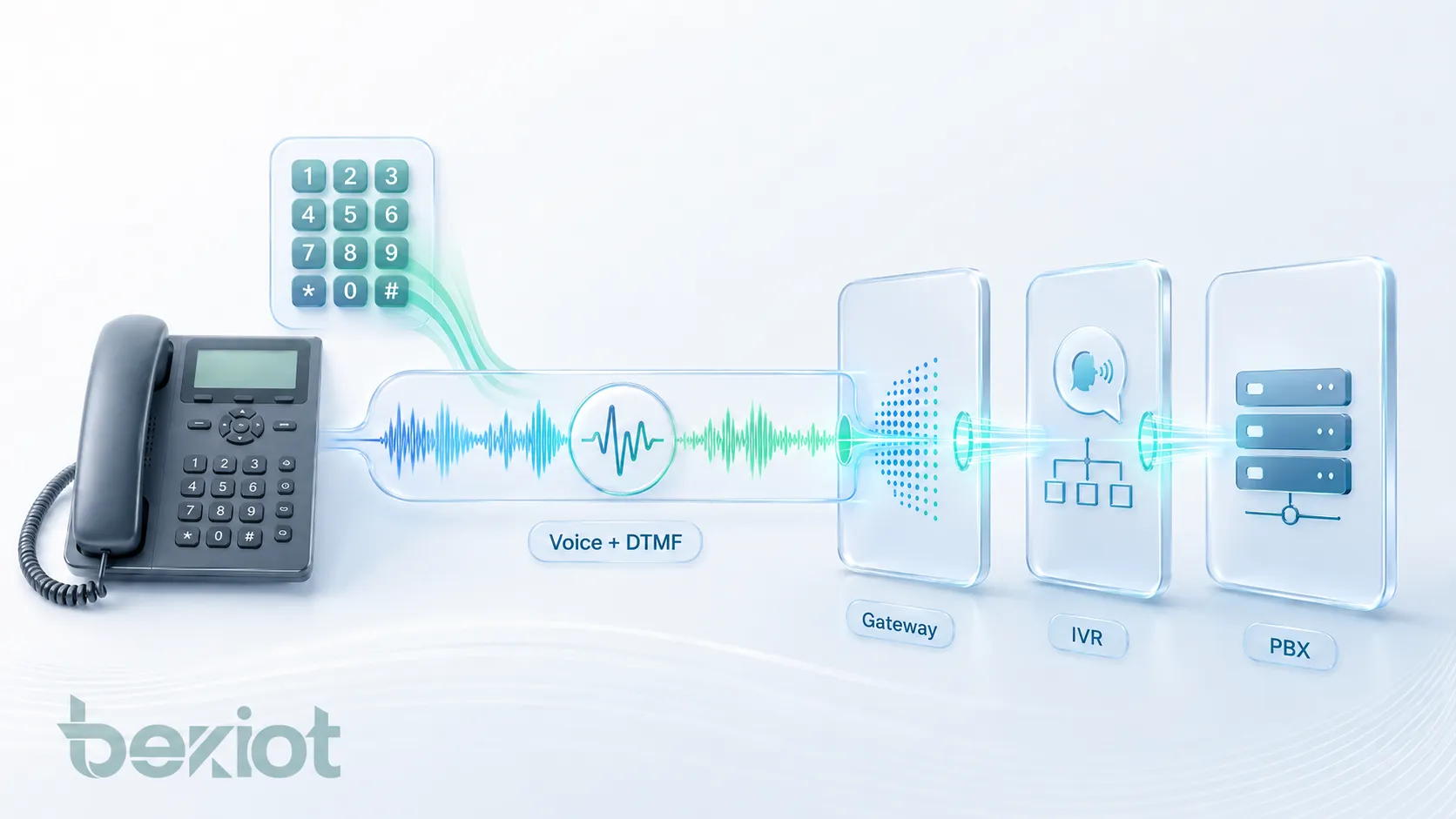
In-band DTMF is a method of sending Dual-Tone Multi-Frequency keypad signals as audible tones inside the same audio stream that carries speech. When a caller presses a key such as 1, 2, 3, *, or #, the phone generates a pair of tones. In an in-band DTMF system, those tones travel through the voice channel just like normal speech audio.
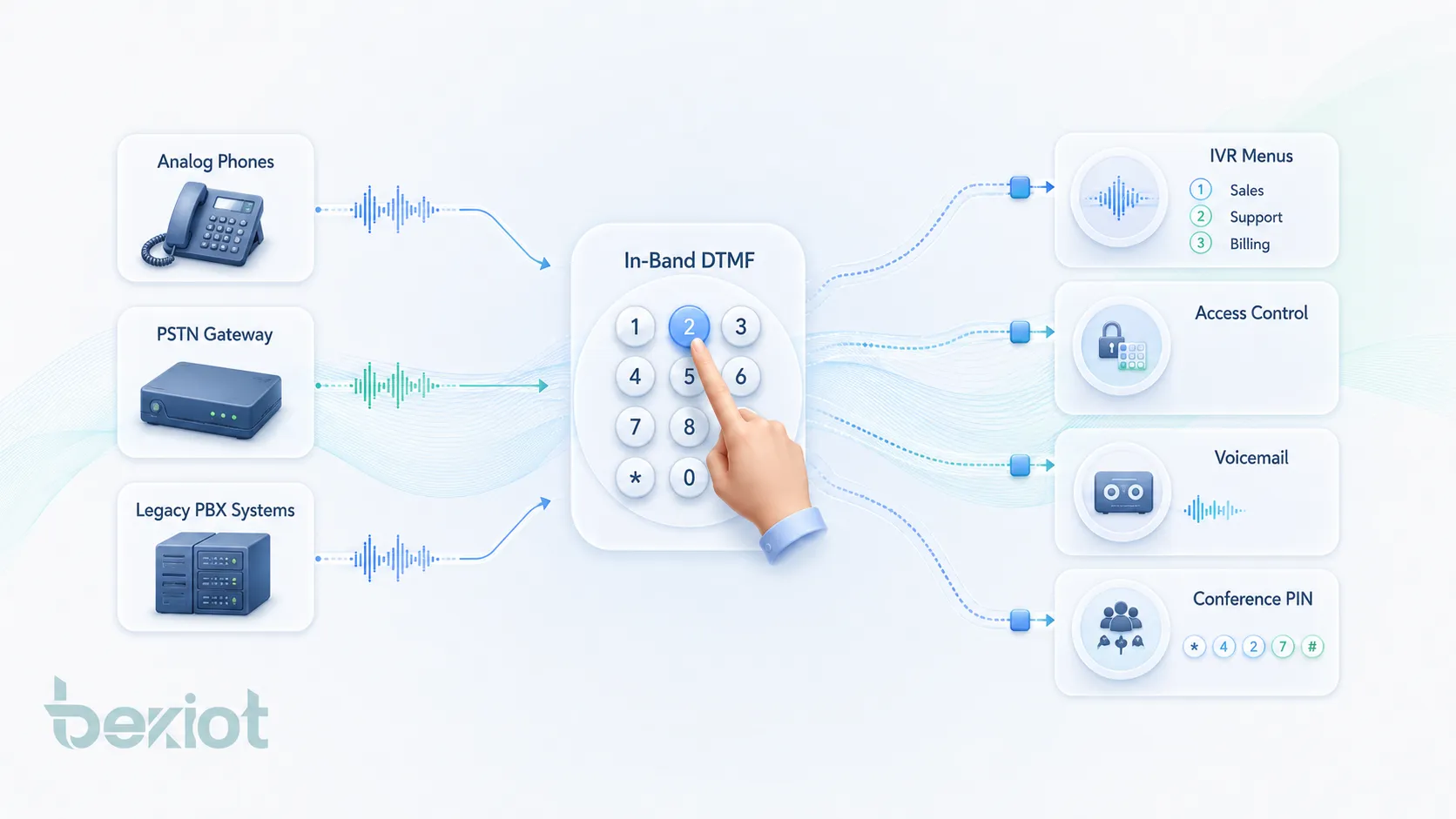
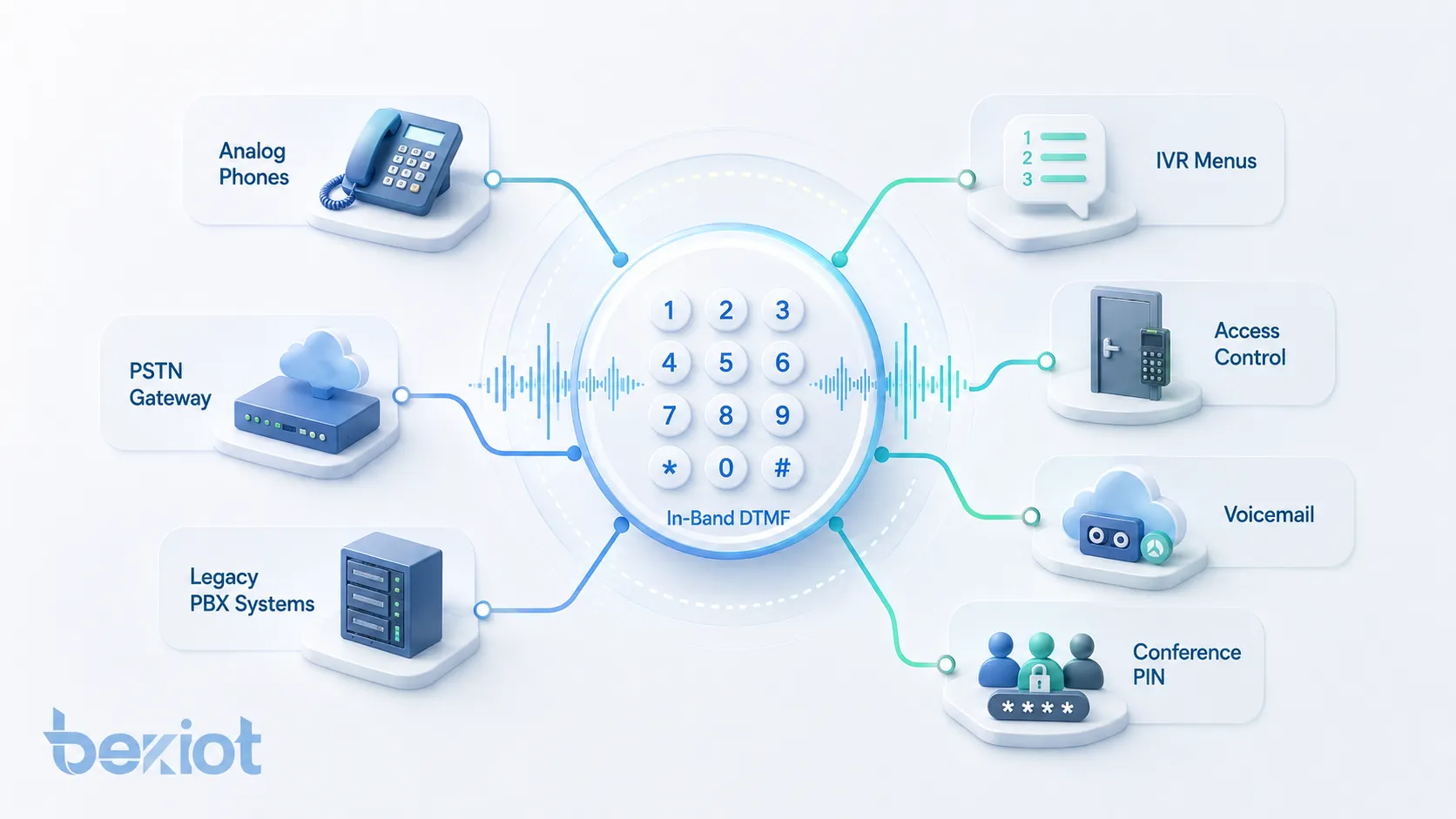
DTMF is commonly used for IVR menus, voicemail access, conference PIN entry, banking systems, access control, call center routing, remote control functions, paging systems, door entry systems, and service hotlines. In-band DTMF is one of the oldest and simplest ways to transmit those keypad tones because it does not require a separate signaling channel.
In modern VoIP and SIP systems, in-band DTMF still appears in many hybrid deployments, especially where analog phones, PSTN gateways, legacy PBX systems, fax-like interfaces, elevator phones, door phones, and older IVR systems are involved. However, it must be used carefully because compression codecs, packet loss, echo cancellation, noise reduction, and audio processing can distort the tones and cause recognition failure.
Что такое внутриполосный DTMF?
Определение и основной смысл
In-band DTMF means that DTMF tones are transmitted within the normal audio path of a call. The tones are not sent as separate SIP messages or separate RTP telephone-event packets. They are part of the same media stream as the caller’s voice. A receiving system detects those tones by listening to the audio and decoding the tone frequencies.
The core meaning is simple audio-based digit transmission. The phone or gateway generates the tones, the voice channel carries them, and the receiving device or application recognizes them. This makes in-band DTMF easy to understand and compatible with many traditional telephony systems.
In analog telephony, in-band DTMF was natural because the call path was an audio circuit. In IP telephony, the method can still work, but only if the voice codec and media path preserve the DTMF tones accurately enough for the receiver to decode them.
In-band DTMF sends keypad digits as real audio tones inside the voice stream, so the receiving system must detect the tones from the call audio.
Почему внутриполосный DTMF всё еще важен
In-band DTMF still matters because many communication systems must interoperate with legacy telephony equipment. Analog gateways, PSTN trunks, door intercoms, elevator emergency phones, older IVR systems, call center platforms, and access control devices may expect DTMF tones to arrive as audible audio.
It is also useful in simple environments where the entire call path uses high-quality uncompressed audio and does not require separate DTMF signaling negotiation. In such cases, in-band DTMF can be straightforward and reliable.
However, in-band DTMF is not always the best choice for modern compressed VoIP paths. If the audio is compressed too aggressively or processed by noise suppression, the tones may be damaged. This is why engineers often compare in-band DTMF with RTP telephone-event methods and SIP INFO when designing VoIP systems.
Как работает внутриполосный DTMF
Формирование двухтонального сигнала
DTMF uses two simultaneous audio frequencies for each keypad digit. One tone comes from a low-frequency group and the other from a high-frequency group. The combination identifies the pressed key. For example, each number key has its own unique pair of tones.
When the user presses a key, the phone generates the corresponding tone pair for a short duration. The receiving device listens for those tone pairs and translates them back into digits. This allows systems to interpret user input without needing a visual keypad interface on the receiving side.
In-band DTMF depends on the audio path preserving these tones accurately. If the tone duration, frequency, volume, or waveform is distorted, the receiving decoder may miss the digit or detect the wrong digit.
Передача через голосовой канал
In an in-band DTMF call, the generated tones travel through the same media stream as speech. In analog systems, that means the tones travel through the telephone audio circuit. In VoIP systems, the tones are encoded by the voice codec and carried as audio packets.
If the codec is transparent enough, the DTMF tones remain recognizable. Codecs such as G.711 are often more suitable for in-band DTMF because they preserve audio more directly. Highly compressed or low-bitrate codecs may damage tone quality and reduce detection reliability.
The audio channel may also pass through gateways, media servers, SBCs, echo cancellers, transcoders, recorders, and IVR platforms. Each step can affect tone quality if not configured properly.
Прием и распознавание тонов
The receiving side must detect the DTMF tones from the audio stream. This may happen in an IVR server, PBX, voicemail platform, gateway, access controller, conferencing bridge, or application server. The detector analyzes the audio and identifies which tone pairs are present.
Detection requires enough tone duration, correct frequency balance, suitable volume, and limited background interference. If a user speaks while pressing keys, if the call has noise, or if audio processing changes the tone, detection may become less reliable.
Good DTMF detection should reject false positives from speech while recognizing real keypad tones accurately. This balance is important because some speech sounds can contain frequency components that resemble tones.
Пример сценария вызова
A common example is an IVR menu. A caller dials a service number and hears “press 1 for sales, press 2 for support.” The caller presses 2. The phone generates the DTMF tone pair for digit 2. The tones travel inside the audio stream. The IVR detects the tone and routes the call to the support queue.
In an access control example, a caller may enter a PIN through the phone keypad. The access system detects the in-band DTMF digits and decides whether to unlock a door, open a gate, or accept a control command.
In both cases, the system works only if the full audio path preserves the tones clearly enough for the receiving decoder.
Технические особенности внутриполосного DTMF
Передача на основе аудио
The defining feature of in-band DTMF is audio-based transmission. The digit is not carried as a separate data event. It is carried as a sound. This makes the method easy to use with systems that understand audio tones.
Audio-based transmission is especially useful when the receiving device is designed for analog-style tone detection. Many legacy systems, simple controllers, and traditional IVR platforms can recognize DTMF from the audio path.
The same feature also creates the main limitation. Because the tones are treated like audio, anything that changes the audio can affect the DTMF signal.
Без отдельного сигнального канала
In-band DTMF does not require a separate signaling channel for digits. The call does not need to send SIP INFO messages or RTP telephone-event packets. The tones are embedded directly in the media stream.
This can simplify interoperability with older systems. If the receiver is listening to the call audio, it can detect the digit without needing special support for out-of-band signaling methods.
However, lack of a separate signaling channel also means the receiving side must rely on audio detection rather than a clean digital event. This can reduce reliability in compressed VoIP environments.
Чувствительность к кодекам
In-band DTMF is sensitive to codec behavior. Codecs designed to compress human speech may not preserve DTMF tones perfectly. They may distort frequencies, change tone duration, reduce volume, or introduce artifacts.
G.711 is commonly preferred when in-band DTMF must be used because it preserves the audio waveform more transparently than many low-bitrate codecs. Codecs such as G.729 or other compressed codecs may cause unreliable DTMF detection in some deployments.
Codec choice is therefore one of the most important technical considerations for in-band DTMF.
Требования к времени и длительности
DTMF detection depends on timing. If the tone is too short, the receiver may not recognize it. If digits are sent too quickly, the receiver may miss one or merge digits. If the tone is too long, it may cause repeated detection depending on the decoder.
Phones, gateways, and IVR systems may allow configuration of DTMF tone duration and inter-digit delay. Proper timing helps improve recognition, especially when the call path includes gateways or audio processing.
Timing should be tested with the actual receiving system because different IVR platforms and controllers may have different tolerance.
Громкость и уровень сигнала
DTMF tones must arrive at a suitable level. If the tone is too quiet, the detector may miss it. If it is too loud, it may clip or distort. Background noise and echo can also interfere with detection.
Gateways and analog interfaces may include gain settings that affect DTMF tone level. Incorrect gain can create intermittent problems where some digits are detected and others are missed.
Reliable in-band DTMF requires proper audio level planning across the complete call path.
Совместимость с аналоговыми системами и PSTN
In-band DTMF is naturally compatible with many analog and PSTN systems because those systems were designed to carry audio tones. When VoIP systems connect to analog trunks or PSTN gateways, in-band DTMF may be required or generated at the gateway boundary.
In hybrid networks, gateways may convert between in-band DTMF and RTP telephone-event formats. For example, a VoIP side may use RFC 4733 telephone events, while the analog side receives regenerated audible tones.
This conversion helps bridge old and new communication technologies, but it must be configured carefully.
Звуковые преимущества внутриполосного DTMF
Простая аудиосовместимость
The main audio benefit of in-band DTMF is simple compatibility with systems that already process audio. Because the digits are audible tones, the receiving system only needs tone detection capability. It does not need to understand SIP INFO, SDP negotiation, or RTP telephone-event payloads.
This makes in-band DTMF useful for legacy PBX systems, analog adapters, access systems, and older IVR platforms. It can help maintain compatibility during migration from traditional telephony to VoIP.
In environments where the audio path is clean and uncompressed, in-band DTMF can work reliably.
Естественная совместимость с аналоговыми интерфейсами
Analog telephony interfaces are designed around audio. In-band DTMF fits naturally because the tones pass through the same circuit as speech. Analog phones, analog gateways, and PSTN-connected devices can generate and detect these tones without separate packet signaling.
This is useful in mixed deployments where analog endpoints remain in use. For example, an analog door phone, elevator phone, or legacy PBX may require audible tones to control menus or functions.
The benefit is strongest when analog compatibility is more important than modern VoIP optimization.
Нет зависимости от поддержки сигнализации
In-band DTMF can work even when the signaling path does not support separate DTMF events. If a device or trunk does not support SIP INFO or RTP telephone-event negotiation, audio tones may still pass through.
This can be helpful in basic connections, older gateways, or systems with limited feature support. The receiving system can still interpret digits if the tones remain intact.
However, this benefit should not hide the reliability limitations. Lack of signaling dependency is useful, but media quality becomes more important.
Простая диагностика на слух
In-band DTMF can sometimes be easier to identify during troubleshooting because the tones are audible. A technician can listen to a call recording or media stream and confirm whether tones are present.
This is different from out-of-band methods, where the digits may be sent as separate events that are not heard in the audio. For basic field troubleshooting, audible tones can help confirm whether the phone generated DTMF at all.
More detailed troubleshooting still requires checking codecs, packet captures, gateway logs, IVR detection settings, and audio levels.
Внутриполосный DTMF и другие методы DTMF
Внутриполосный DTMF и RTP telephone-event
RTP telephone-event, commonly associated with RFC 2833 and its successor RFC 4733, sends DTMF digits as RTP events rather than as ordinary audio tones. The digit information travels in the media path, but it is represented as a structured event instead of encoded speech audio.
This method is often preferred in VoIP because it is less affected by voice compression. The system does not need the codec to preserve the tone waveform. Instead, it sends a digital representation of the digit, duration, and event information.
In-band DTMF is simpler for audio-based systems, while RTP telephone-event is usually more reliable in compressed IP voice networks.
Внутриполосный DTMF и SIP INFO
SIP INFO sends DTMF information through SIP signaling during an active session. Instead of putting the digit in the audio path, the endpoint sends an INFO message that carries the digit information to the receiving system.
SIP INFO can avoid audio codec distortion because the digit is not transmitted as audio. However, it depends on signaling path support and interoperability. Different platforms may implement SIP INFO DTMF differently, so compatibility should be tested.
In-band DTMF is media-based, RTP telephone-event is event-based in RTP, and SIP INFO is signaling-based. Choosing the right method depends on endpoint support, gateways, trunks, IVR requirements, and network design.
Внутриполосный DTMF и внеполосный DTMF
Out-of-band DTMF means the digit is sent outside the normal speech audio. RTP telephone-event and SIP INFO are common examples. The purpose is to avoid relying on audio tone preservation.
Out-of-band methods are often better for VoIP systems using compressed codecs or complex media processing. They can improve digit recognition for IVR menus, contact centers, and SIP trunks.
In-band DTMF remains useful when legacy audio tone compatibility is required or when the call path is known to preserve tones accurately.
Выбор метода в гибридных сетях
Hybrid networks often require conversion between methods. A SIP trunk may use RTP telephone-event, while an analog device requires in-band tones. A gateway may detect RTP telephone events and regenerate audible DTMF on the analog side.
The opposite may also happen. An analog phone may send in-band tones to a VoIP gateway, and the gateway may convert those tones into RTP telephone events for the IP side.
Proper gateway configuration is essential. If both sides generate DTMF at the same time or if conversion is disabled, duplicate digits or missing digits can occur.
Применение внутриполосного DTMF
Навигация по меню IVR
IVR systems use DTMF to let callers choose menu options. A caller may press 1 for sales, 2 for support, or 0 for an operator. In-band DTMF can be used when the IVR detects digits from the audio stream.
This is common in traditional telephony and some gateway-connected VoIP systems. It works best when the audio path uses a suitable codec and avoids excessive processing.
If callers report that menu selections are not recognized, DTMF method and codec configuration should be checked.
Голосовая почта и ввод PIN для конференций
Voicemail systems and conference bridges often require users to enter PINs, mailbox numbers, or menu commands. In-band DTMF can carry these digits as audible tones.
This is useful when the voicemail or conference system expects audio tone detection. However, if users connect through compressed VoIP paths, digit recognition may become unreliable.
For modern SIP conference systems, RTP telephone-event is often preferred, but in-band DTMF may still be needed for legacy interconnection.
Контроль доступа и открывание дверей
Access control systems may use DTMF digits for door release, gate control, elevator control, or remote command input. A user may call an intercom and press a digit or code to open a door.
In-band DTMF is common in older door phone and access systems because the controller listens for audible tones. When these systems are connected to VoIP through gateways, maintaining proper in-band tone quality becomes important.
Access control applications should be designed carefully because tone-based control can affect physical security. Authentication, caller permission, and command restrictions should be considered.
Удаленное управление и автоматизация
Some remote systems use DTMF for simple control commands. A user can press keys to start, stop, reset, unlock, acknowledge, or select a function. In-band DTMF allows these commands to be carried through an audio channel.
This may appear in legacy automation, paging control, alarm acknowledgment, radio interfaces, utility systems, or simple telephone-controlled devices. It is useful where a full data interface is not available.
For critical controls, DTMF should be combined with authorization and logging. Simple tone control alone may not be secure enough for sensitive operations.
Взаимодействие PSTN-шлюзов и аналоговых адаптеров
PSTN gateways and analog telephone adapters often need to handle in-band DTMF. Analog devices generate tones naturally, while IP networks may prefer telephone-event signaling. Gateways may detect, pass through, suppress, or regenerate tones depending on configuration.
This is common in systems that connect analog phones, fax-like devices, elevator phones, alarm panels, door phones, or legacy PBX equipment to SIP trunks or IP PBX systems.
Gateway DTMF settings should be matched with the SIP server, trunk provider, and endpoint requirements to avoid missed or duplicated digits.
Контакт-центры и системы обслуживания клиентов
Call centers rely on DTMF for IVR selection, account number entry, payment routing, agent transfer, and customer self-service. In-band DTMF may be present when calls arrive from PSTN or analog-connected systems.
For call centers, DTMF reliability affects customer experience. If digits fail, callers may repeat entries, reach the wrong queue, or abandon the call.
Modern contact centers often prefer out-of-band methods for VoIP paths, but in-band compatibility may still be required for certain trunks, gateways, and customer access paths.
Рекомендации по внедрению
Выбор правильного кодека
Codec choice is the first deployment consideration for in-band DTMF. If in-band tones must be preserved, use a codec that carries tones accurately. G.711 is commonly used for this reason.
Low-bitrate codecs may reduce bandwidth, but they can distort DTMF tones. If the call path must use compressed codecs, RTP telephone-event may be a better option.
Codec policy should match the DTMF method. Do not assume that in-band DTMF will work reliably through every codec.
Исключение вредной обработки аудио
Audio processing features can affect in-band DTMF. Echo cancellation, noise suppression, automatic gain control, voice activity detection, silence suppression, and transcoding may alter the tone signal.
These features are useful for speech quality, but they may interfere with tone detection if configured poorly. Some systems include special DTMF detection and suppression logic to prevent issues.
In-band DTMF should be tested with all media processing enabled exactly as it will be used in production.
Проверка конфигурации шлюза
Gateways often provide DTMF mode settings such as in-band, RFC 2833 or RFC 4733 telephone-event, SIP INFO, auto, or conversion modes. Incorrect gateway configuration is a common cause of DTMF failure.
If an analog device sends in-band tones, the gateway may pass them through as audio or convert them into telephone events. If the VoIP side sends telephone events, the gateway may regenerate audible tones for the analog side.
The gateway, SIP server, trunk provider, and endpoint must agree on how DTMF is handled.
Тестирование реальных маршрутов вызовов
DTMF should be tested across real call paths, not only between two local extensions. Test internal calls, SIP trunk calls, PSTN calls, mobile calls, IVR access, voicemail access, access control commands, and conference PIN entry.
A method that works internally may fail through a trunk or gateway because the codec, media path, or DTMF conversion changes. Testing should include all important scenarios.
Real call path testing helps prevent customer-facing failures after deployment.
Предотвращение дублирования цифр
Duplicate digits can occur when in-band tones and out-of-band events are both delivered to the receiving system. For example, a gateway may pass the audible tone while also generating an RTP telephone-event digit.
The receiving system may then detect the same key twice. This can cause wrong IVR selections, invalid PINs, or failed access commands.
Systems should be configured to pass, suppress, or convert DTMF consistently so that only one usable digit method reaches the receiving application.
In-band DTMF deployment depends on codec selection, audio processing, gateway behavior, tone levels, timing, and end-to-end call path testing.
Типичные проблемы внутриполосного DTMF
Цифры не распознаются
The most common problem is that digits are not detected by the receiving system. This may happen because the codec distorted the tones, the tones were too short, the level was too low, or audio processing removed part of the signal.
Troubleshooting should check codec, DTMF mode, gateway settings, IVR detector settings, tone duration, packet loss, and whether the tones are audible in the media stream.
If in-band detection remains unreliable, switching to RTP telephone-event may be the better solution for VoIP paths.
Распознаются неверные цифры
Wrong digit detection can occur when tones are distorted or when speech or noise resembles DTMF frequencies. Although modern detectors try to avoid false positives, poor audio conditions can still cause errors.
This problem is more likely in noisy environments, compressed media paths, or systems with incorrect gain levels. It can affect IVR menus, PIN entry, and remote control commands.
Audio level adjustment, codec changes, and detector tuning may help reduce wrong detection.
Дублирование цифр
Duplicate digits may occur when a digit is carried in more than one method at the same time. For example, the in-band tone may remain in the audio while a gateway also sends an RTP telephone event.
Duplicate digits can cause serious user experience problems. A caller who presses 1 may be interpreted as pressing 11. A PIN may fail because each digit is counted twice.
The solution is usually to configure DTMF suppression or conversion properly so that the receiving system gets only one digit source.
Сбои при использовании сжатых кодеков
Compressed codecs are a frequent cause of in-band DTMF failure. Codecs optimized for speech may not reproduce DTMF tones with enough accuracy. This can cause missed digits or incorrect detection.
If bandwidth savings are required, using out-of-band DTMF may be better than trying to force in-band tones through a low-bitrate codec.
For in-band DTMF, G.711-style audio is often safer than aggressive compression.
Проблемы DTMF в одном направлении
Sometimes DTMF works in one direction but not the other. A caller can send digits to the IVR, but the remote system cannot send commands back, or vice versa. This may indicate asymmetric gateway settings, different codecs, NAT traversal issues, or different media paths.
Troubleshooting should check both call directions and both signaling and media traces. It should not assume that DTMF works both ways simply because it works in one direction.
Directional testing is important in gateways, trunks, intercoms, and access control systems.
Лучшие практики внутриполосного DTMF
Используйте внутриполосный режим только там, где это уместно
In-band DTMF should be used when the receiving system expects audible tones or when legacy compatibility requires it. It is suitable for analog interfaces, some PSTN paths, and simple tone-controlled systems.
For pure VoIP paths, especially those using compression, RTP telephone-event is often more reliable. The best method depends on the complete system rather than one device setting.
Avoid using in-band DTMF by default without checking the call path and receiving application.
Предпочитайте прозрачные аудиокодеки
If in-band DTMF is required, use codecs that preserve tones well. G.711 is commonly used because it carries audio more transparently than many compressed codecs.
Codec negotiation should be controlled so that calls requiring in-band DTMF do not unexpectedly fall back to a codec that damages tone quality.
Codec policy should be documented for trunks, gateways, endpoints, and IVR systems.
Настраивайте шлюзы согласованно
Gateways should be configured consistently across the network. Decide whether the gateway passes in-band tones, converts them to RTP telephone events, converts telephone events back to tones, or suppresses duplicate audio.
Inconsistent gateway settings can create hard-to-diagnose problems, especially in multi-site systems or when different trunks use different requirements.
A clear DTMF plan should be part of VoIP gateway deployment.
Проверяйте тайминг, уровень и точность цифр
Testing should include digit duration, inter-digit delay, tone level, detection accuracy, and repeated input. Test not only digits 0 to 9, but also * and # if they are used by the application.
Test with the actual IVR, voicemail, conference system, door controller, or application that will receive the digits. A successful test with one receiver does not guarantee success with another.
DTMF testing should be included in commissioning and after any codec, trunk, gateway, or IVR change.
Документируйте метод DTMF по маршрутам
Large systems may use different DTMF methods on different routes. Internal SIP calls may use RTP telephone-event. Analog gateway calls may require in-band. A SIP trunk may require a specific negotiated payload. A legacy access system may need audio tones.
Documenting the expected DTMF method by route makes troubleshooting easier. It also helps future engineers avoid changing settings without understanding the impact.
DTMF documentation should include endpoint settings, gateway settings, trunk provider requirements, and receiving application requirements.
Советы по обслуживанию и диагностике
Записывайте и сигнализацию, и медиапоток
DTMF troubleshooting often requires checking both signaling and media. SIP messages can show whether telephone-event or SIP INFO is negotiated. Media capture can show whether in-band tones are present in the audio stream.
If the system claims to use in-band DTMF, the tones should be audible or visible in the media waveform. If the system uses RTP telephone-event, the digits may appear as separate RTP payload events.
Understanding which method is actually used is the first step in solving DTMF problems.
Проверяйте согласование кодеков
Codec negotiation should be checked whenever in-band DTMF fails. A call may use G.711 in one direction and a compressed codec in another. A trunk may force transcoding. A conference bridge may change the media format.
If in-band DTMF passes through transcoding, detection reliability may decrease. Engineers should review SDP, gateway logs, and media server behavior.
Codec mismatch is one of the most common reasons DTMF works in some calls but not others.
Проверяйте настройки IVR и приложений
The receiving application may have its own DTMF detection settings. IVR platforms, voicemail servers, conference bridges, and access controllers may allow configuration of detection sensitivity, minimum tone duration, timeout, and accepted digits.
If the receiver expects out-of-band events but receives in-band tones, it may not process the digits. If it expects in-band tones but the gateway suppresses them, digits may be missing.
Application settings should match the DTMF method delivered by the call path.
Прослушивайте наличие искажений
Listening to a call recording or packet capture can help identify tone distortion. If DTMF tones sound clipped, weak, noisy, or broken, the receiver may not decode them reliably.
Distortion may be caused by gain problems, compression, packet loss, echo cancellers, acoustic feedback, or poor analog interface quality.
Audio inspection is especially useful when troubleshooting in-band DTMF because the digits are carried as sound.
Тестируйте после изменений сети или транков
DTMF behavior can change after a SIP trunk migration, gateway replacement, codec policy update, SBC change, IVR upgrade, or carrier routing change. A call may still connect normally while DTMF stops working.
After any major communication change, test IVR menus, voicemail PINs, conference access, access control commands, and other DTMF-dependent functions.
DTMF should be part of regression testing for VoIP changes.
Внутриполосный DTMF в безопасности и пользовательском опыте
Ввод PIN и конфиденциальность
DTMF is often used for PIN entry. In in-band mode, the tones may be present in the audio stream. If calls are recorded, the tones may also be captured unless the system masks, suppresses, or protects them.
For sensitive applications such as banking, payment, access control, or account verification, organizations should consider how DTMF digits are protected. Some systems use secure input methods, DTMF masking, or separate payment capture tools.
In-band DTMF should be evaluated carefully when digits represent passwords, PINs, or sensitive commands.
Ложный ввод и неправильная маршрутизация
Poor DTMF detection can affect user experience. A missed digit may keep the caller in the same IVR menu. A wrong digit may route the caller to the wrong department. Duplicate digits may cause PIN failure.
These problems can frustrate users and increase call handling time. In customer service environments, unreliable DTMF can increase agent workload because callers cannot complete self-service steps.
Good DTMF design supports both technical reliability and customer experience.
Авторизация команд
When DTMF is used to control doors, gates, alarms, paging, or automation systems, authorization becomes important. Anyone who can send the correct tones may be able to trigger the function if no additional controls exist.
Sensitive functions should not rely only on simple DTMF digits. Caller ID validation, authentication, access lists, time rules, logging, and operator confirmation may be needed.
DTMF is useful for control input, but it should be integrated into a secure control workflow.
Заключение
In-band DTMF is a method of transmitting keypad digits as audible tones inside the same audio stream that carries speech. It is simple, familiar, and compatible with many analog, PSTN, IVR, voicemail, conference, access control, and legacy PBX systems.
Its main technical features include audio-based transmission, no separate signaling channel, compatibility with analog interfaces, sensitivity to codec behavior, dependence on tone duration and level, and the need for accurate receiver detection. Its main benefits are legacy compatibility, simple audio-path operation, and natural fit with analog telephony.
In modern VoIP systems, in-band DTMF should be used carefully. It works best with transparent audio paths such as G.711 and may become unreliable with compressed codecs, transcoding, noise suppression, echo cancellation, packet loss, or inconsistent gateway configuration. For many SIP and IP voice deployments, RTP telephone-event methods based on RFC 4733 are often more reliable, while SIP INFO may be used in some signaling-based implementations. The best choice depends on endpoints, gateways, trunks, IVR platforms, and real call path testing.
FAQ
Что такое внутриполосный DTMF простыми словами?
In-band DTMF means keypad digits are sent as audible tones inside the normal voice audio stream. The receiving system listens to the audio and detects the tones.
It is commonly used with analog phones, PSTN systems, IVR menus, voicemail, and some legacy communication systems.
В чем разница между внутриполосным DTMF и RFC 2833 или RFC 4733?
In-band DTMF sends the digit as audio tones. RFC 2833 and RFC 4733 send DTMF as structured RTP telephone-event packets instead of ordinary speech audio.
RTP telephone-event is usually more reliable in VoIP networks because it is less affected by voice codec compression.
Какой кодек лучше для внутриполосного DTMF?
G.711 is commonly preferred for in-band DTMF because it preserves audio tones more transparently than many compressed codecs.
Low-bitrate codecs may distort DTMF tones and cause missed or incorrect digit detection.
Почему внутриполосный DTMF иногда не работает в VoIP?
In-band DTMF can fail because of compressed codecs, transcoding, packet loss, echo cancellation, noise suppression, wrong gain levels, short tone duration, or gateway misconfiguration.
Testing the complete call path is necessary because DTMF may work on one route but fail on another.
Где обычно используется внутриполосный DTMF?
It is commonly used in IVR menus, voicemail systems, conference PIN entry, access control, door entry systems, analog gateways, PSTN connections, legacy PBX systems, and remote control applications.
It is especially useful when the receiving system expects audible DTMF tones.
Безопасен ли внутриполосный DTMF для ввода PIN?
In-band DTMF may expose PIN tones inside the audio stream and possibly in call recordings. Sensitive applications should consider masking, secure input methods, access control, encryption, or alternative signaling methods.
For payments, banking, and access control, DTMF security should be evaluated carefully.