

Tunnel Emergency Communication System for Intercom and Paging
A tunnel emergency communication system is designed to provide reliable voice communication, paging, alarm notification, and dispatch coordination in road tunnels, railway tunnels, metro tunnels, utility tunnels, mining tunnels, and other underground infrastructure. In these environments, clear and immediate communication is essential because drivers, passengers, maintenance teams, operators, and emergency responders may need assistance within a confined, noisy, and signal-limited space.
Becke Telcom provides an integrated tunnel emergency communication solution that combines SIP intercom, industrial emergency telephones, IP paging, PA speakers, horn speakers, dispatch consoles, video linkage, alarm inputs, and centralized management software. The system helps tunnel operators build a unified communication network for daily operation, incident response, evacuation guidance, maintenance coordination, and emergency command.

Communication Challenges in Tunnel Environments
Limited Visibility, High Noise, and Long Linear Spaces
Tunnels are different from ordinary buildings or open public areas. They are long, enclosed, and often divided into multiple zones, cross passages, equipment rooms, escape routes, and maintenance areas. When a fire, vehicle accident, equipment failure, flooding event, or abnormal gas alarm occurs, operators must communicate quickly with people inside the tunnel and coordinate multiple response teams at the same time.
The tunnel environment also creates acoustic and technical challenges. Vehicle noise, ventilation fans, echoes, concrete structures, and signal shielding can reduce speech intelligibility. A general office telephone system or simple public address system is often not enough. A dedicated tunnel intercom and paging system must be designed for emergency priority, wide-area coverage, rugged field deployment, and centralized dispatch control.
Why Independent Subsystems Are Not Enough
Many tunnel projects are equipped with separate telephone systems, PA systems, CCTV systems, fire alarm systems, radio systems, and traffic control systems. When these systems operate independently, the control center may need to switch between different platforms during an emergency. This increases response time and makes incident handling less efficient.
A modern tunnel emergency communication system should connect intercom, paging, telephony, alarm, video, and dispatch into one coordinated workflow. When a call or alarm is triggered, the control room should be able to identify the location, speak with the person on site, view nearby video, start a zone broadcast, call maintenance staff, and record the event from one unified platform.
The purpose of a tunnel emergency communication system is not only to make calls. It is to help operators hear, speak, locate, broadcast, coordinate, and respond when every second matters.
Becke Telcom Solution Overview
Integrated SIP Intercom and IP Paging Architecture
The Becke Telcom tunnel emergency communication system is built on an IP and SIP-based architecture. SIP emergency telephones, SIP intercom terminals, IP paging amplifiers, SIP horn speakers, paging microphones, dispatch consoles, and IP PBX or SIP servers can be connected through the tunnel communication network. This allows voice calls, emergency intercom, paging announcements, and dispatch operations to share a unified communication platform.
The system can be deployed in a local tunnel control center, a regional monitoring center, or a multi-site command center. It supports private network deployment, LAN/WAN networking, fiber backbone transmission, PoE endpoint access, and integration with existing tunnel management systems. For long tunnels or multi-section projects, the system can be divided into zones so operators can manage calls, alarms, and broadcasts according to tunnel section, lane, equipment room, or emergency exit.
Designed for Emergency Response and Daily Operation
In daily operation, the system supports maintenance calls, routine paging, traffic guidance announcements, equipment room communication, and operator-to-field coordination. In emergency situations, it supports one-touch emergency calls, high-priority paging, evacuation announcements, alarm-triggered broadcasts, dispatch conference calls, video pop-up linkage, and call recording.
This dual-use design helps tunnel operators avoid building separate systems for daily communication and emergency communication. One unified platform can support routine management, maintenance coordination, public safety announcements, emergency response, and post-event traceability.
System Architecture
Field Communication Layer
The field communication layer includes industrial telephones, emergency call stations, SIP intercom terminals, SOS help points, wall-mounted IP phones, weatherproof telephones, explosion-proof telephones for special hazardous areas, SIP speakers, horn speakers, column speakers, and IP paging amplifiers. These devices are installed in tunnel portals, emergency bays, evacuation passages, equipment rooms, cross passages, pump rooms, electrical rooms, control cabinets, and maintenance zones.
For noisy tunnel sections, horn speakers and high-power paging amplifiers can provide stronger sound projection. For maintenance areas and emergency call points, rugged SIP telephones or intercom stations allow staff and stranded users to contact the control center directly. For special industrial tunnels, chemical tunnels, mining access tunnels, or utility corridors with potential gas risks, explosion-proof or highly protected communication terminals can be selected according to the site requirement.
Network and Transmission Layer
The network layer connects all field devices to the control center through industrial Ethernet switches, fiber-optic backbone, PoE switches, private IP networks, VLAN segmentation, and optional wireless or 4G/5G backup links. In tunnel environments, fiber ring networks and redundant power design are often recommended to improve communication continuity.
The system can be deployed across different tunnel sections and control rooms. For long-distance tunnels, local devices can connect to zone-level switches and then uplink to the central communication server. This structure helps reduce cabling complexity, simplifies maintenance, and supports future expansion.
Control and Dispatch Layer
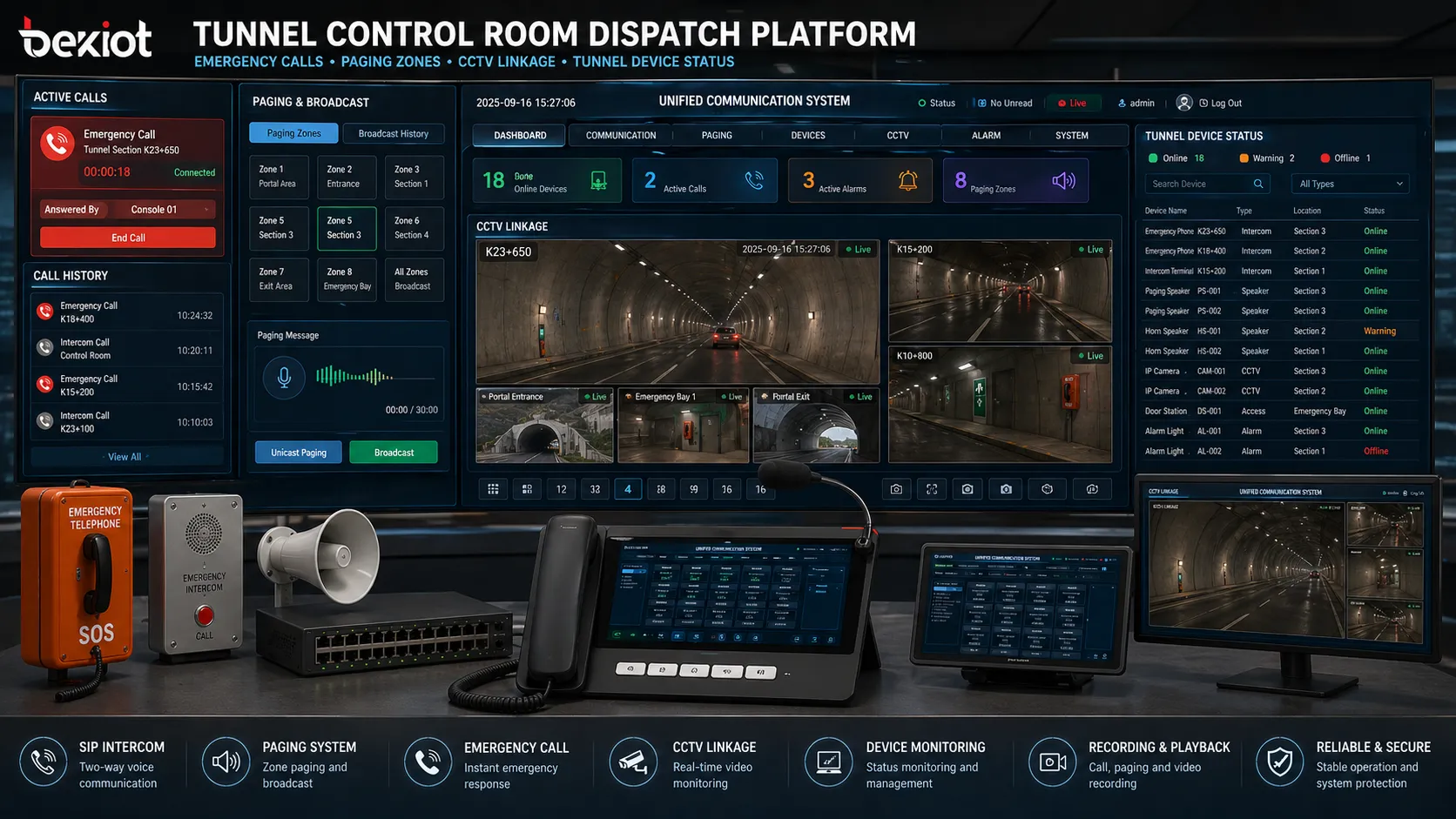
The control and dispatch layer includes the SIP server, IP PBX, dispatch platform, paging server, recording server, management software, and visual dispatch console. Operators can answer emergency calls, initiate paging, monitor device status, transfer calls, create group calls, start emergency conferences, and manage communication zones through a unified interface.
The dispatch platform can display tunnel sections, device status, call status, alarm status, and linked camera information. When a field device initiates an emergency call, the system can show the location of the call point, open the related video channel, record the call, and guide the operator to take the next action.
Integration Layer
The tunnel emergency communication system can be integrated with CCTV platforms, fire alarm systems, traffic control systems, SCADA systems, access control systems, radio communication systems, and emergency management platforms. Common integration methods may include SIP, ONVIF, RTSP, GB/T 28181, dry contact input/output, API interface, relay linkage, and customized software integration.
Through integration, a tunnel operator can build an event-driven workflow. For example, when a fire alarm is triggered, the system can automatically start an evacuation broadcast in the affected zone, notify operators, link nearby cameras, and call designated maintenance or rescue personnel.

Core Functions of the Tunnel Emergency Communication System
Emergency Intercom and SOS Calling
Emergency telephones and SIP intercom stations allow people inside the tunnel to call the monitoring center with one button. The call can be routed to the main control room, secondary control room, duty phone, mobile phone, or emergency command platform. If the first operator is busy or unavailable, the system can support call forwarding, timeout forwarding, group ringing, or escalation routing.
This function is especially important for accident reporting, maintenance communication, stranded vehicle assistance, fire confirmation, equipment failure reporting, and emergency rescue coordination. Calls can be recorded for event review, liability tracing, training, and operational improvement.
Zone Paging and Emergency Broadcast
Tunnel paging can be divided by tunnel section, direction, lane, emergency bay, equipment room, evacuation passage, or portal area. Operators can make live announcements to a single zone, multiple zones, or the entire tunnel. The system can also play pre-recorded emergency messages, safety reminders, traffic guidance, maintenance notices, and evacuation instructions.
Emergency paging can be assigned a higher priority than routine announcements or background audio. When an urgent event occurs, the emergency broadcast can interrupt lower-priority audio and restore previous playback after the emergency message ends. This helps ensure that evacuation instructions and safety warnings are delivered clearly and without delay.
Video Linkage and Visual Verification
When an emergency call or alarm occurs, the system can link with nearby tunnel cameras. The control room can view the location, verify the situation, and communicate with the person on site. Video linkage helps operators avoid blind response and improves the accuracy of dispatch decisions.
For tunnels with many call points and cameras, map-based or zone-based linkage can reduce operator workload. Instead of manually searching for the correct camera, the system can automatically display the related video channel according to the call point or alarm location.
Dispatch, Conference, and Multi-Party Coordination
Emergency response usually involves more than one person. The control center may need to connect tunnel operators, maintenance staff, police, fire rescue, traffic management personnel, tow truck teams, and management leaders. The Becke Telcom solution supports dispatch calling, group calling, conference communication, call transfer, and communication with mobile staff.
For projects that use radios, a ROIP gateway can connect analog or digital radio users with the SIP dispatch platform. This allows the control room to communicate with patrol teams, maintenance teams, and rescue teams through the same operational workflow.
Alarm Linkage and Emergency Workflow
The system can connect with fire alarms, manual alarm buttons, intrusion alarms, gas sensors, smoke detectors, water level alarms, door contacts, and other tunnel safety systems. When an alarm is triggered, the platform can notify operators, link video, start paging, activate sirens or beacons, and call predefined emergency contacts.
This turns communication from a passive calling tool into an active emergency response workflow. Operators can respond faster, reduce manual steps, and keep a complete record of the event handling process.
Recording, Logging, and Traceability
Emergency calls, paging operations, dispatch conversations, and alarm events can be recorded and logged. These records help tunnel operators review incidents, verify response time, improve procedures, and support safety audits.
For public transportation tunnels, highway tunnels, utility tunnels, and industrial tunnel projects, traceability is a key part of long-term safety management. A communication system with recording and event history can support both operational management and compliance needs.
Typical Application Areas
Highway and Road Tunnels
In highway and road tunnels, emergency telephones, SIP intercoms, horn speakers, and control room dispatch systems help operators handle vehicle accidents, breakdowns, smoke events, congestion, fire alarms, and evacuation guidance. Paging can be used for traffic instructions, safety warnings, and emergency evacuation messages.
The system can be deployed at tunnel portals, emergency stopping areas, cross passages, ventilation rooms, electrical rooms, and monitoring points. Operators can communicate with drivers, maintenance teams, and rescue personnel from the control center.
Metro, Railway, and Underground Transit Tunnels
Metro and railway tunnels require reliable communication between station control rooms, operation control centers, platform staff, maintenance teams, and tunnel personnel. SIP intercom and paging systems can support evacuation guidance, maintenance calls, incident reporting, and coordination with station PA or emergency broadcast systems.
The solution can also connect with video surveillance and emergency management platforms to provide visual dispatch and coordinated response across stations, platforms, tunnels, and maintenance sections.
Utility Tunnels and Underground Corridors
Utility tunnels often contain power cables, communication cables, water pipelines, gas pipelines, and other critical infrastructure. Operators need reliable communication for inspection, maintenance, fire alarm response, and emergency evacuation. Industrial telephones, IP intercoms, paging speakers, and alarm linkage can help improve safety for personnel working inside confined underground spaces.
In utility tunnel projects, the system can be integrated with environmental monitoring, gas detection, access control, CCTV, and central monitoring platforms. When abnormal conditions are detected, the system can provide immediate communication and broadcast guidance.
Mining, Industrial, and Special-Purpose Tunnels
Industrial tunnels and mining-related underground access areas may require higher device protection, stronger audio output, and integration with special safety systems. Depending on the environment, weatherproof, dustproof, corrosion-resistant, or explosion-proof communication terminals may be selected.
Becke Telcom can provide customized endpoint selection and system integration for different tunnel applications, including industrial plants, energy facilities, mining operations, water conservancy projects, underground logistics passages, and emergency shelters.

Deployment Considerations
Zone Planning and Speaker Coverage
A tunnel paging system should be planned according to tunnel length, acoustic conditions, speaker direction, background noise, evacuation routes, and emergency zones. Horn speakers, column speakers, ceiling speakers, and paging amplifiers should be selected according to the required sound pressure level and installation position.
For long tunnels, separate paging zones help operators broadcast targeted messages instead of sending every announcement to the entire tunnel. This reduces confusion and improves evacuation guidance.
Endpoint Protection and Installation Environment
Tunnel devices may face dust, humidity, vibration, exhaust gas, temperature change, water spray, and electromagnetic interference. Field communication terminals should be selected with suitable IP protection, rugged housings, corrosion resistance, and stable operation under industrial conditions.
Emergency telephones and intercom stations should be installed in visible and accessible locations. Clear labeling, lighting, and proper mounting height can help drivers, passengers, and maintenance workers use the system quickly during emergencies.
Network Redundancy and Power Reliability
Emergency communication must remain available when ordinary systems are under stress. Tunnel projects should consider redundant network paths, fiber ring topology, UPS backup, protected power supply, and local fallback strategies. Critical endpoints and control room equipment should be designed for high availability.
For important tunnel sections, local survivability can also be considered. Even if connection to a higher-level control center is interrupted, local emergency calls and paging should remain available wherever possible.
Integration with Existing Tunnel Systems
Many tunnel projects already have CCTV, fire alarm, traffic monitoring, SCADA, access control, and radio systems. A new communication system should not create another isolated platform. It should provide open interfaces and standard protocols to support integration with existing infrastructure.
Becke Telcom supports flexible integration based on project requirements. This helps system integrators and tunnel operators build a practical solution without unnecessary replacement of existing assets.
Key Benefits of the Becke Telcom Tunnel Communication Solution
Unified Communication and Centralized Control
The solution integrates intercom, paging, telephony, dispatch, video linkage, alarm notification, and recording into one communication platform. Operators can manage tunnel communication from a centralized control room instead of switching between multiple independent systems.
Faster Emergency Response
One-touch calling, automatic location identification, video linkage, priority paging, and predefined emergency workflows help operators respond faster when incidents occur. The system reduces manual operation and improves coordination between control room staff and field response teams.
Clear Voice and Strong Paging Coverage
SIP-based intercom terminals and paging devices support high-quality voice transmission. With proper speaker planning and zone design, the system can provide clear announcements in noisy tunnel environments.
Flexible Expansion and Multi-Site Management
The IP-based architecture supports scalable deployment from a small tunnel to a large tunnel network. New call points, speakers, dispatch seats, gateways, and integration modules can be added according to project expansion.
Better Operation, Maintenance, and Traceability
Centralized management, device status monitoring, call recording, event logs, and remote configuration help reduce maintenance workload. Operators can review emergency handling records and improve long-term tunnel safety management.
Becke Telcom helps tunnel operators build a communication system that connects people, devices, alarms, and command workflows into one reliable emergency response network.
Recommended System Components
Field Endpoints
Recommended field endpoints include SIP emergency telephones, weatherproof industrial telephones, tunnel help points, SIP intercom stations, emergency call boxes, horn speakers, SIP column speakers, IP paging amplifiers, alarm buttons, and optional sound-and-light alarm devices.
Control Room Equipment
The control room can include SIP server or IP PBX software, visual dispatch console, paging microphone, operator station, recording server, video linkage interface, management platform, and emergency workflow software.
Integration Devices
Depending on the project, the system can include ROIP gateways, analog telephone gateways, SIP gateways, relay I/O modules, video platform interfaces, and third-party system integration modules.
Why Choose Becke Telcom
Becke Telcom focuses on industrial communication, emergency communication, SIP intercom, IP paging, dispatch communication, and rugged communication terminals for demanding environments. For tunnel projects, Becke Telcom can provide not only individual devices but also a complete solution covering system design, endpoint selection, dispatch workflow, paging planning, integration support, and long-term operation.
Whether the project is a highway tunnel, railway tunnel, metro tunnel, utility tunnel, underground industrial corridor, or public safety infrastructure, Becke Telcom can help build a reliable tunnel emergency communication system for intercom and paging.
Contact Becke Telcom to design a tunnel emergency communication system with SIP intercom, IP paging, industrial telephones, video linkage, and dispatch integration for your project.